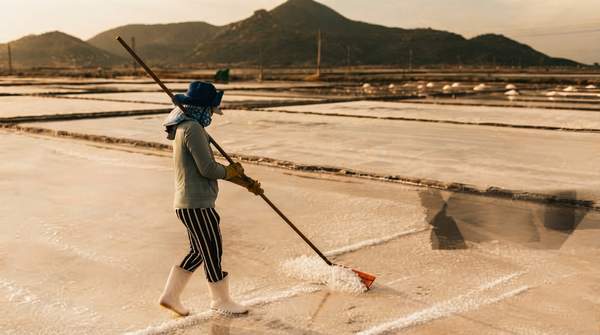
Choosing an artisanal salt comes down to two questions: what do you want it to taste like, and what do you want it to do on the plate? A delicate Fleur de Sel scattered over a ripe tomato salad behaves nothing like earthy red Alaea salt crusted onto a pork loin, and neither can stand in for a coarse smoked salt when you want a wood-fire character without lighting a smoker. This guide compares five salts—Fleur de Sel, Sel Gris, smoked salt, Alaea (red Hawaiian) salt, and Hiwa Kai (black Hawaiian) salt—across the three criteria that actually drive the choice: flavor, texture, and best use, so you can pick the right one for the job, whether that is finishing fresh vegetables or seasoning a roast.
Core Principles for Choosing Artisanal Salts
Texture and origin drive everything. Where a salt comes from, how it is harvested, and what is added to it determine its mineral content and crystal structure, and those two things together shape both its flavor and its culinary function. SaltWorks, a specialty salt purveyor, notes that within the Guérande region of the French Atlantic coast, different areas produce salts with their own unique flavor and aroma profiles, much like wine regions—so origin is not marketing decoration; it is the salt's terroir, and it shows up on the tongue.
Processing matters just as much. Smoked salt gets its entire personality from the smoking process: the type of wood used and the length of smoking determine both its flavor and its color, as culinary educator Sarah Larson explains. Alaea salt owes its character to a natural additive—volcanic red clay, traditionally added to enrich sea salt with trace amounts of iron oxide. Hiwa Kai takes a different additive route, incorporating activated charcoal for its striking color and silky texture.
Texture then determines how salt meets food. Fine, moist crystals melt slowly on the tongue and deliver gentle, lingering salinity, while coarser grains sit on the surface of food and crunch. That physical difference is why delicate salts belong at the end of cooking or on the plate, where their texture can be experienced, while robust, mineral-rich salts can stand up to the heat of cooking. When you are evaluating a salt you encounter outside this guide, Dava Guthmiller, writing for the food letter A Dash Of, points out that artisan producers are typically transparent about their methods and sources, and their websites are a good place to find recipes and use tips for a specific salt.
Fleur de Sel vs. Sel Gris: A Tale of Two French Salts
These two salts come from the same Guérande evaporation pans—just different layers, as the French culinary reference La Pincée puts it: same pans, different layers. That single distinction in harvesting explains nearly everything about how differently they behave in your kitchen.
True Fleur de Sel consists of young crystals that form naturally on the surface of the salt evaporation ponds. The region's harvesters, known as paludiers, carefully rake the crystals using traditional wooden tools, and the weather conditions must be just right to produce a true harvest—the process can be completed only once a year, during the summer. The result is a rare, delicate, fine, moist crystal with a round salinity and faint violet notes, a product whose scarcity and careful handling are inseparable from its character.
Sel Gris, by contrast, is harvested from the bottom of those same pans, where the crystals come into contact with the clay lining of the basins. That contact gives it a coarser, moister, more mineral-heavy character compared with the fine, delicate surface crystals of Fleur de Sel. The practical consequence for you as a cook: Fleur de Sel is a finishing salt, sprinkled just before serving, while the sturdier Sel Gris can season throughout cooking. If you are choosing between them, let the moment of application decide—surface sparkle or deep seasoning.