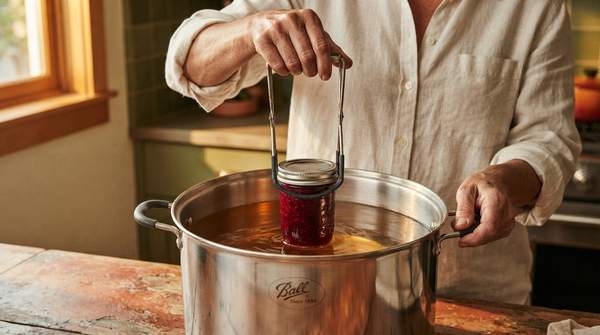
Water bath canning is safe for one reason and one reason only: the food is acidic enough that Clostridium botulinum spores cannot grow. The boiling water bath, which heats food to 212°F, cannot destroy those spores. Instead, safety rests on three scientific pillars working together—acidity that blocks botulism, heat that destroys yeasts, molds, and vegetative bacteria, and a vacuum seal that keeps oxygen and new contamination out. Understand these pillars, and you can trace every rule in a tested recipe back to the threat it neutralizes.
The Core Science of Water Bath Canning Safety
Every canning rule exists to answer one question: which microorganisms could survive, and what stops them? The National Center for Home Food Preservation explains that Clostridium botulinum exists as spores or as vegetative cells. The spores sit harmlessly on most fresh food surfaces, but when conditions suit them—moist, low-acid food, temperatures between 40° and 120°F, and less than 2 percent oxygen—they produce vegetative cells that multiply rapidly and can generate a deadly toxin within 3 to 4 days.
Notice what that list describes: a sealed jar of low-acid food is exactly the environment botulism wants. This is why the method matters so much. The food's acid content, or pH, is the key factor in determining the minimally safe processing method, according to the NCHFP: boiling water for acid foods, pressure canning for low-acid foods. Water bath canning works only when acidity has already disarmed the botulism threat.
Pillar 1: Acidity (pH) – The Botulism Barrier
The critical threshold is a pH of 4.6. Foods below 4.6 are classified as high-acid; foods at 4.6 or above are low-acid, and that distinction determines which canning method you may use. Virginia Cooperative Extension is direct about the stakes: high-acid foods prevent the growth of C. botulinum spores, which cannot be killed by boiling, while foods above pH 4.6 allow the spores to grow—and if they grow, toxin forms, and consuming that toxin is deadly.
Here is the part many canners miss: the spores are not destroyed in a water bath. They may still be in your jar. Acidity works differently—it prevents their germination and growth for the life of the jar. That is why you cannot simply extend the boiling time to make a low-acid food safe. The barrier is chemical, not thermal, and no amount of boiling substitutes for it.
Pillar 2: Heat Penetration – Destroying Spoilage Microbes
Boiling water at 212°F does real work—it just isn't botulism work. The heat is sufficient to kill vegetative bacterial cells in the food, and it destroys yeasts, molds, and the enzymes that cause spoilage. This is what makes the product shelf-stable rather than merely sealed.
Time matters as much as temperature. The NCHFP notes that the amount of time jars are held at a certain temperature during canning is important to producing a safe product, and that elevation affects processing because boiling points drop at altitude. Heat must penetrate to the center of every jar, so processing times vary by food, jar size, and altitude, and must be followed precisely from a current, tested recipe. Cutting time short means the coldest spot in the jar may not reach the temperature the recipe was designed around.
Pillar 3: Oxygen Removal and Vacuum Seal – Preventing Recontamination
The third pillar is physical. Headspace—the gap between the food's surface and the lid—is one of the key factors in determining whether you get a good vacuum seal, as Elizabeth Andress, then project director of the NCHFP, has explained. During processing, air is driven out of the jar; as the jar cools at room temperature, the lid compound softens during heating and hardens while cooling, forming a tight seal and pulling a vacuum.
Getting the gap right is where science meets technique. Virginia Cooperative Extension warns that too little headspace lets food boil up and out of the jar, preventing a seal, while too much headspace may leave the processing time inadequate to drive off the oxygen, again preventing the seal. The USDA Complete Guide to Home Canning recommends 1/4 inch for jams and jellies and 1/2 inch for fruits and tomatoes processed in a boiling water bath. A failed seal means oxygen and airborne contamination can re-enter—and an unsealed jar is a jar you must reprocess or refrigerate.
The Three Pillars of Water Bath Canning Safety: An Explanatory Model
Use this model to trace any step in a water bath recipe back to the threat it addresses. Each row connects a safety principle, your action as the canner, the microbial target, and the scientific rationale behind it.
| Safety Principle | Canner's Action | Microbial Threat Neutralized | Scientific Rationale |
|---|---|---|---|
| Acidity (pH) | Select naturally high-acid foods, or acidify low-acid foods to below pH 4.6 following a tested recipe | Germination and growth of C. botulinum spores | Spores survive boiling, but pH at or below 4.6 prevents them from growing and producing toxin |
| Heat (Temperature) | Process jars fully submerged in boiling water (212°F) for the exact tested time for your food, jar size, and altitude | Yeasts, molds, enzymes, and vegetative bacterial cells | Boiling destroys spoilage organisms and their enzymes; time ensures heat reaches the jar's coldest spot |
| Oxygen Removal (Vacuum Seal) | Leave the specified headspace, apply lids, and let jars cool undisturbed at room temperature | Aerobic spoilage organisms and recontamination from the environment | Heating drives air out; cooling pulls a vacuum so the hardened lid seals the jar against oxygen and new microbes |
Notice the division of labor: acidity handles the one threat heat cannot, heat handles the threats acidity doesn't target, and the seal preserves the environment both created. Remove any one pillar and the system fails—which is why shortcuts in a single step can compromise an entire batch.
Guide to Water Bath Canning Suitability: High-Acid, Acidified, and Unsafe Foods
Deciding whether a food belongs in a water bath comes down to one question: is its pH below 4.6, naturally or by measured acidification? Cornell's Fruition seed library, drawing on the USDA Guide to Home Canning, groups safe foods into two categories—naturally high-acid and acidified—while Virginia Cooperative Extension lists the low-acid foods that must never take this route.
- Naturally high-acid foods: Most fruits, including berries, plus fruit jellies, jams, butters, marmalades, and preserves. These sit naturally below pH 4.6 and need no added acid.
- Acidified foods: Pickles, relishes, and acidified tomatoes. These are naturally low-acid foods brought below pH 4.6 by vinegar, lemon juice, or fermentation acid—only when a tested recipe specifies the amounts.
- Unsafe for water bath canning (low-acid, pH above 4.6): Asparagus, beans, beets, carrots, corn, hominy, meat, mushrooms, okra, peas, potatoes, spinach, squash, and seafood. These require pressure canning.
The acidified category deserves special care. Pickled cucumbers are safe because the vinegar solution, not the cucumber, provides the safety margin—and the exact ratio comes from a tested recipe, never estimation. Modern tomato varieties, meanwhile, can drift toward the pH boundary, which is why current guidance treats tomatoes as a food requiring acidification.
Canning with Confidence: Identifying Safe Foods and Understanding the 'Why'
You can confidently assess whether a food suits water bath canning by asking where its pH falls and whether any acidification comes from a tested recipe. This article covers the science of the water bath method only; it does not provide pressure canning instructions or specific processing times, and it is never a substitute for tested recipes from the NCHFP or your university extension.
Here is your check: take a food you plan to can—green beans, peaches, pickled cucumbers—and categorize it. Green beans are low-acid, so they require pressure canning. Peaches are naturally high-acid and safe in a water bath. Pickled cucumbers are safe only because a tested recipe's vinegar brings them below pH 4.6. For each one, name the pillar doing the work: acidity blocking botulism spores, 212°F heat destroying yeasts, molds, and vegetative cells, and correct headspace forming the vacuum seal. When you can categorize the food and explain the pillar behind every step, you have moved from following rules to understanding them—and that understanding is what lets you spot an unsafe shortcut before it becomes a dangerous jar.