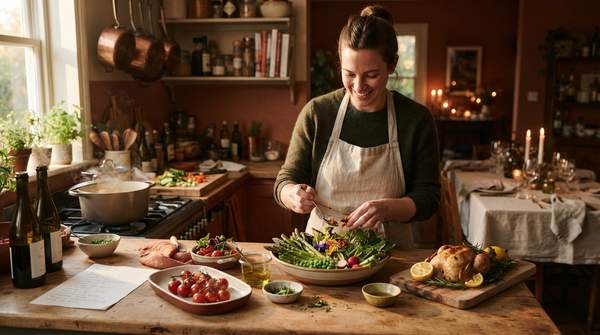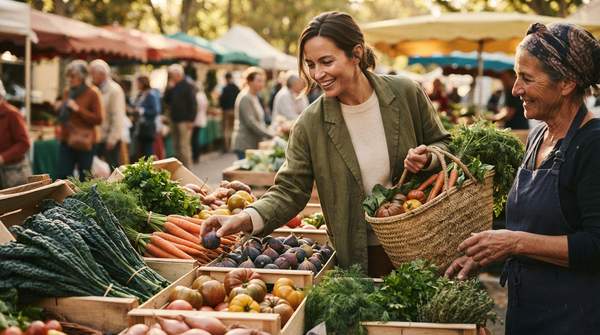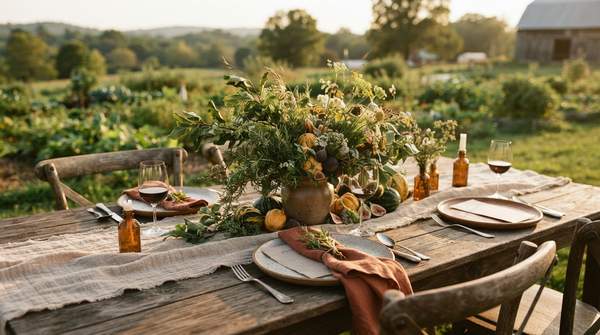
A farm-to-table tablescape succeeds not because of what you buy, but because of the order in which you decide. Start with the season, let it dictate your palette, then layer textures and vary heights, and the table will feel intentional rather than assembled. The guidance below draws on seasonal examples from designers and home entertainers—from a summer al fresco dinner to a New England harvest buffet—and distills them into a repeatable method you can apply to any month of the year.
Embracing the Farm-to-Table Ethos in Your Decor
The farm-to-table ethos is about letting the season's own materials tell the story. HGTV's Liz Gray frames it simply: draw inspiration from the season's flowers, plants and foliage to create a casual setting suited to dining alfresco, mixing DIY projects with vintage finds for a rustic-chic look. The point is that the decor and the meal share a single source—the fields and markets of the moment.
Éléonore Le Corre, writing on her blog Une Bonne Maison, offers a lived example. Having once lived in New England, she recalls heading to farms each autumn to pick apples and pumpkins, and later styled a harvest-festival table where the decorations were destined for the soup pot. Her reasoning is quietly sustainable: why deprive yourself of decorative produce when it will end up being cooked? That double duty—beauty first, dinner after—is the heart of the aesthetic.
Your Seasonal Tablescape Decision Framework
Work through the four decisions below in order. Each one constrains the next, which is what keeps the final table cohesive instead of cluttered.
| Step | Design Principle | How to Apply It | Seasonal Examples from the Evidence |
|---|---|---|---|
| 1. Season & Venue | Establish your foundation | Identify what your local farms, markets and landscape offer right now; the season dictates the theme and available materials. | Autumn pumpkin-picking trips in New England; a late-summer harvest of lettuce, kohlrabi and cucumbers at Arrows Farm. |
| 2. Color Palette | Select your hues | Let the natural tones of seasonal flowers, foliage and produce set the scheme rather than choosing colors in the abstract. | Pumpkins in different shapes and colors; the season's flowers and foliage as palette inspiration. |
| 3. Textures & Materials | Add depth and interest | Pair soft linens with rough wood and smooth glass so the eye and hand find contrast. | Wooden boards, mason jars, wooden baskets and crates, simple linens, bud vases. |
| 4. Heights & Scale | Create visual flow | Place elements at different levels—stacked produce, vases, logs or crates—so the table doesn't read flat. | Large pumpkins stacked on top; dishes set at different heights on wooden logs; low votive candles. |
The sequence matters. If you choose a palette before checking what's actually in season locally, you risk a table that looks imported rather than grown. If you skip the height step, even abundant arrangements can appear static. Follow the order, and the result is a plan that reflects the season and avoids a random, cluttered appearance.