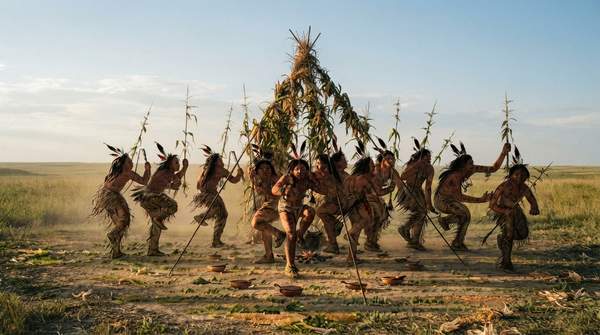
The foods at the heart of the world's harvest festivals are not arbitrary choices. Across three celebrations on three continents—the Green Corn Ceremony of the Southeastern United States, China's Mid-Autumn Festival, and West Africa's New Yam Festival—the signature dishes trace a direct line back to the crop or celestial event each festival was built around. Understanding that connection transforms a plate of corn, a mooncake, or a yam from festival fare into a record of agricultural history.
Green Corn Ceremony: A Celebration of Renewal and First Harvest
For centuries, the Indigenous Nations of the Southeastern United States have marked the ripening of the season's first corn with the Green Corn Ceremony, held in mid-summer when the early corn became ripe. The Encyclopedia of Alabama, in an article by Eric E. Bowne, describes it as the most important of the region's many annual ceremonies, noting that it likely existed in some version among most Indian groups of the Southeast. Also known as the busk, from the Creek word poskita, "to fast," the ceremony generally lasted four or eight days and paired fasting with feasting and acts of social and material renewal.
Its scope was remarkable. Bowne cites the anthropologist Charles Hudson's observation that modern Americans would have to combine Thanksgiving, New Year's Day, Yom Kippur, Lent, and Mardi Gras to approach the ceremony's breadth and importance. That breadth is visible in its customs: homes and public spaces were thoroughly cleaned, all fires were put out, and old food was eaten to clear the way for a fresh start. As The Pluralism Project recounts, the New Year then began with a priest silently kindling a new flame and offering the first of the ripening corn, followed by a dance and feast.
The food, in other words, was the ritual. As a PBS documentary on the ceremony's revival explains, as participants partake in the preparation and consumption of freshly harvested corn, they express appreciation for the Earth's abundance. Traditions vary from Nation to Nation, as Honest History notes, but typically involve dancing, feasting, fasting, and religious observations.
The ceremony is very much alive. When the Ho-Chunk Nation gathered for its annual Green Corn Celebration, the smell of corn, venison, and wood smoke filled the air alongside a community potluck, cooking and craft demonstrations, and social and green corn dances, as reported by Native News Online. Knowledge keepers shared language and traditional food preparation while younger participants learned how to prepare, serve, and respect the ingredients. "The Green Corn is really about showing our gratefulness for the things we still have today," Ho-Chunk Nation president Jon Greendeer told the publication.
Mid-Autumn Festival: Honoring the Moon and Abundance
Where the Green Corn Ceremony looks to the field, the Mid-Autumn Festival looks to the sky. Held in September or October, when the moon is believed to be at its fullest and brightest, the festival's origins date back more than 3,000 years, when it was first observed to show gratitude to the moon for a good harvest. The timing is agricultural at its core: the full moon of early autumn coincided with the completion of the harvest, and the moon itself was thanked as the source of that abundance.
The festival's most iconic food encodes that symbolism in pastry form. Mooncakes—round, like the moon they honor—are filled, depending on the region, with sweet-bean paste, egg yolk, meat, or lotus-seed paste. The circular shape mirrors the full moon that the festival celebrates, and sharing them remains a central act of family togetherness. Today, celebrations include ceremonies to give thanks, spending time with family, and eating mooncakes, a continuity of practice stretching back millennia.
The tradition has also traveled far beyond its birthplace. Full-moon festivals are now celebrated throughout Asia, including in Taiwan, Vietnam, Korea, Japan, Singapore, Cambodia, Malaysia, Indonesia, and Thailand. Each region has adapted the celebration to its own harvest calendar and culinary traditions, but the essential structure endures: a full moon, a completed harvest, and a shared food that embodies both.
New Yam Festival: Gratitude for West Africa's Staple Crop
In West Africa, the harvest festival centers on the crop that sustains the community: the yam. Tribes across the region celebrate the Festival of Yams, and in Nigeria it is an important tradition of the Igbo, Yoruba, and Idoma peoples, deeply tied to their spiritual beliefs and prosperity. The festival is usually held at the beginning of August, at the end of the rainy season in Ghana and Nigeria—the moment when the new yam crop is ready.
The ceremony's structure reveals its agricultural logic. According to a Bowling Green State University digital exhibit on harvest festivals, celebrants offer yams to the gods and their ancestors before distributing them to the rest of the village, giving thanks to the spirits for a bountiful harvest. The sequence matters: the first yams belong not to the living community but to the spiritual forces believed to have granted the harvest. Only after that offering does the crop become food for everyone else.
That order of operations—gratitude first, consumption second—echoes the Green Corn Ceremony's priest offering the first ripening corn before the feast. Across continents and crops, the pattern repeats: the season's first harvest is treated as sacred before it becomes sustenance. The yam itself carries the festival's meaning; a staple crop that can be stored through difficult months, it represents both the year's labor and the community's security, which is why its arrival warrants celebration by entire villages.
Harvest Festivals: From Field to Feast
Placed side by side, these three festivals reveal a consistent pattern: each celebration's core agricultural purpose is directly reflected in its central dishes. Use the table below to trace how a first corn harvest, a full moon, or a yam crop became the culinary centerpiece of a living tradition.
| Festival | Cultural Origin | Agricultural Purpose | Ancient Practice | Modern Culinary Tradition |
|---|---|---|---|---|
| Green Corn Ceremony | Indigenous Nations of the Southeastern United States | Marks the first ripened corn of mid-summer, signifying renewal and the New Year | A priest offered the first ripening corn after new fire was kindled; feasting followed fasting and cleaning of homes | Community potlucks and traditional food preparation, with knowledge keepers teaching younger participants to prepare and respect the ingredients |
| Mid-Autumn Festival | China, now celebrated across East and Southeast Asia | Honors the full moon and the autumn harvest, dating back over 3,000 years | Observed to show gratitude to the moon for a good harvest | Round mooncakes filled with sweet-bean, egg yolk, meat, or lotus-seed paste, shared with family |
| New Yam Festival | West Africa, including the Igbo, Yoruba, and Idoma in Nigeria | Celebrates the yam harvest at the end of the rainy season, in early August | Yams were offered to the gods and ancestors before distribution to the village | Yam dishes remain the festival's centerpiece, eaten only after the first fruits are spiritually offered |
The comparison shows that the line from field to feast is short and unbroken. The crop that defined the ancient harvest still defines the modern table, and the ritual order—offering, gratitude, then communal eating—survives in each tradition.
Embracing the Harvest: A Continuous Tradition
Readers should recognize that modern harvest festival culinary traditions are not arbitrary, but are deeply rooted in ancient agricultural practices and cultural values. The mooncake is a full moon in pastry; the first corn of the Green Corn Ceremony is an offering before it is a meal; the New Yam Festival's dishes follow a spiritual debt already paid. None of these foods was chosen for taste alone—each was chosen because it embodied the harvest itself.
The measurable outcome for readers is an increased appreciation for the historical and agricultural context when participating in or learning about harvest festivals. The next time a mooncake is shared under an autumn moon, or corn is served at a community gathering, the food on the table can be read as what the evidence shows it to be: a direct, living descendant of the agricultural event that first brought people together to give thanks.
Sources
- Green Corn Ceremony - Encyclopedia of Alabama
- Green Corn Ceremonies — Pluralism
- Ritual | Inside the Revival of an Ancient Indigenous Ritual | Season 1 — PBS
- Celebrating Harvest Around the World — Honest History
- Green Corn Celebration Reconnects Ho-Chunk Nation to Ancestral Foods and Lands — Native News Online
- Harvest Festivals — Digitalgallery