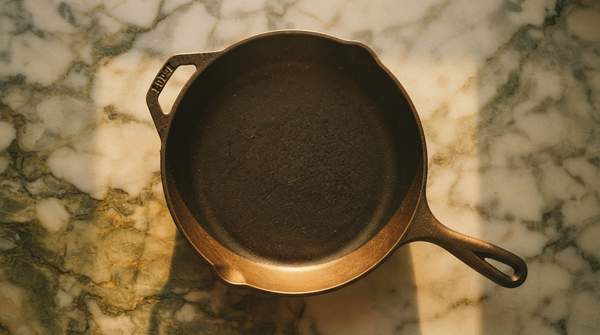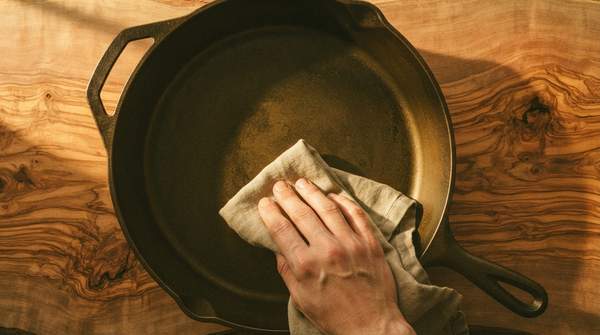
Cast iron seasoning is not a layer of grease sitting on top of the pan. It is a chemically transformed coating: heat breaks the fatty acid chains in oil apart, and the resulting fragments cross-link into a hard, plastic-like polymer that bonds to the iron itself. That single process, called polymerization, explains nearly every rule of seasoning — why you need an oil rich in unsaturated fats, why the pan must get hot enough to push the oil past its smoke point, and why a thin wipe of oil works while a thick pour turns sticky. Once you understand the reaction, choosing an oil and following a method stops being folklore and becomes applied chemistry.
The Chemistry of Cast Iron Seasoning: Polymerization Explained
Start with why food sticks at all. As Andy Brunning explains in a Chemical & Engineering News graphic produced for the American Chemical Society, food sticks to pans because chemical bonds form between the food and the pan surface — and protein-rich foods are especially prone to this, since their proteins form complexes with metal atoms in the cookware. Cast iron, an alloy of iron, carbon, and silicon, offers plenty of metal for those bonds to grab.
Seasoning interrupts that bonding. The process begins with a thin layer of oil applied to the pan and baked at high temperature, repeatedly. Inside that oil are triglycerides, each carrying fatty acids with long hydrocarbon chains. At seasoning temperatures, Brunning explains, those chains break down, and the carbon-carbon double bonds in the chains polymerize into large, complex polymer molecules that lodge in the pores and crevices of the pan. The finished layer stops sticking two ways: it smooths the surface and it repels water.
The key structural detail is the double bond. Oils high in unsaturated fats contain more carbon-carbon double bonds, and — in Brunning's summary of the chemistry — they polymerize more easily. Each double bond is a potential connection point where broken chain fragments can join into a larger, tougher network.
Heat is the trigger. Sheryl Canter, writing on her own blog about the science of the technique, describes the mechanism plainly: to initiate or accelerate the release of free radicals, you put the oil in contact with bare iron and heat it above its smoke point, which causes even non-drying oils to release free radicals. Those radicals then cross-link, and the molecular structure of the oil changes into "something else, something tough and solid." You don't need to master the organic chemistry, she notes — you need to know that the transformation happens, and that heat above the smoke point is what drives it.
One practical reassurance from the same chemistry: because the seasoning is a polymerized solid rather than a film of loose fat, washing the pan with dish soap doesn't damage it, according to Brunning's account. The layer is not oil anymore; it is a different substance.
Choosing the Right Oil: Fatty Acids and Smoke Points
Two properties decide how well an oil will season cast iron: how many double bonds its fatty acids carry, and how much heat it takes to push it past its smoke point. The first determines how many cross-linking sites exist; the second determines whether your oven can actually start the reaction.
The smoke point itself has a chemical basis. As ThermoWorks' Martin Earl outlines, oils are molecules built from three fatty acids of varying lengths connected to a glycerol molecule, and the smoke point is the temperature at which that structure begins breaking down. Reference chemistry compiled from Frank Gunstone's Vegetable Oils in Food Technology adds that the smoke point of a fat or oil drops when it is partially split into free fatty acids and glycerol, because the glycerol decomposes into acrolein — the major component of the smoke you see. A partially hydrolyzed oil, in other words, smokes at a lower temperature than a fresh one.
What does this mean for oil selection? The writers at Kitchn, in a comparison of five oils for seasoning, put it in kitchen terms: bacon grease, lard, and coconut oil aren't the best choices because they're high in saturated fats, while vegetable, canola, flaxseed, and grapeseed oils — each low in saturated fat — do work. Lodge, the cast iron manufacturer, seasons its own cookware in the foundry with a thin sprayed layer of soy-based vegetable oil, and for home re-seasoning recommends a neutral oil with a high smoke point, noting its test kitchen often reaches for vegetable or canola oil because both are affordable and work well.
Canter's analysis adds a historical note: fat polymerization is maximized with a drying oil, and flaxseed oil is the only drying oil that's edible — which is why she singles it out as an ideal seasoning oil. She also passes along a caution worth repeating: some people season with hardware-store linseed oil because it gives the hardest surface, but that product is not food-safe, and she doesn't recommend it.
Oil Suitability for Cast Iron Seasoning
The table below ranks common oils by correlating their fatty acid composition with their polymerization potential, using the chemistry described above. The reasoning path is direct: more unsaturated fat means more carbon-carbon double bonds, which means more sites for cross-linking into a hard polymer — provided the pan is heated past the oil's smoke point to release the free radicals that start the reaction.
| Oil | Fatty Acid Profile | Polymerization Potential | Verdict for Seasoning |
|---|---|---|---|
| Flaxseed oil | High in unsaturated fats; the only edible drying oil | Highest — drying oils polymerize most readily | Excellent; hardens into a tough layer |
| Grapeseed oil | Low in saturated fat | High — many double bonds for cross-linking | Very good choice |
| Canola oil | Low in saturated fat | High — polymerizes easily when heated past smoke point | Very good; affordable, neutral flavor |
| Vegetable (soy-based) oil | Low in saturated fat | High — the oil Lodge uses in its foundry | Very good; proven at scale |
| Bacon grease, lard, coconut oil | High in saturated fats | Low — fewer double bonds for cross-linking | Not recommended for building seasoning |
The evidence-derived result: oils high in unsaturated fats — grapeseed, canola, flaxseed, and vegetable oil — are generally more effective for seasoning because they offer more polymerization sites, provided they are heated above their smoke point. Oils high in saturated fats, such as bacon grease, lard, and coconut oil, are less suitable.
Step-by-Step: Achieving a Durable Seasoning Layer
With the chemistry in hand, the method follows logically. You are engineering a polymerization reaction on the surface of the pan, so each step exists to serve that reaction: thin oil so the layer can harden fully, high heat so the oil breaks down, and repetition so the polymer builds in layers.
- Start with clean, bare iron. This guide covers initial seasoning and re-seasoning of bare cast iron, not daily cooking or cleaning. The oil needs direct contact with the iron surface — Canter notes that contact with bare iron helps initiate the release of free radicals.
- Apply a very thin, even layer of oil. This is the step home cooks most often get wrong. Excess oil cannot fully polymerize and will remain sticky or gummy instead of hardening, which is why the thin application is critical to a hard, plastic-like finish.
- Heat the pan above the oil's smoke point. Kitchn's testing puts the working range at 350°F to 500°F for at least an hour — hot enough to break the oil down and trigger polymerization, but not so hot that the oil simply burns. "Low and slow" fails here; it just makes these oils sticky.
- Bake for a full hour, then let the pan cool completely. Cooling between rounds lets each polymer layer set before the next is applied.
- Repeat three to four times. Multiple cycles build a durable, multi-layered seasoning rather than a single fragile coat.
Lodge's foundry practice mirrors this at industrial scale: a thin sprayed layer of soy-based vegetable oil, baked in a large oven, leaves cookware seasoned and ready to use straight from production. The home version is the same reaction, done in your kitchen.
Two boundaries on this guide: it doesn't address seasoning other cookware such as carbon steel or aluminum, and the chemistry here is deliberately simplified for a general audience rather than presented as a formal academic treatment. It also isn't medical or nutritional advice about consuming heated oils.
Achieving Optimal Cast Iron Seasoning
To achieve a durable, non-stick cast iron seasoning, select an oil high in unsaturated fats, apply it in a very thin layer, and bake the pan at 450–500°F for one hour, repeating three to four times with complete cooling between layers. The reasoning behind each choice is the same chemistry throughout: unsaturated fats supply the double bonds, heat past the smoke point releases the free radicals, and thin layers ensure every drop of oil converts into polymer rather than lingering as sticky residue.
You'll know the method worked by a measurable outcome: a hard, dark surface that isn't tacky to the touch and that lets food release easily during cooking. If your pan comes out of the oven sticky instead, the diagnosis points back to the science — either too much oil was applied or the heat didn't reach the oil's smoke point — and the fix is another thin round at the correct temperature, not a change of approach.
Sources
- Chemistry of Cast Iron Seasoning: A Science-Based How-To — Sherylcanter
- Periodic Graphics: The chemistry of cast-iron cookware — Chemical & Engineering News
- Oil Smoke Points: Temperature Chart — ThermoWorks
- We Seasoned Cast Iron Skillets with 5 Different Oils and Have a New Favorite — Kitchn
- What oils should you use for cast iron cooking and seasoning? — Lodge Cast Iron