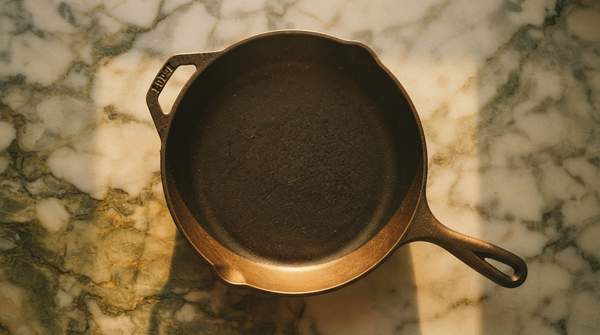
Cast iron's famous non-stick surface is not a coating you buy; it is a coating you build. When a thin layer of oil is baked onto the metal at high temperature, it polymerizes—the fat molecules link into a hard, plastic-like film. Every common cast iron problem, from gummy residue to flaking black bits to red rust, is a specific failure of that chemistry or of the iron beneath it. Once you understand what the seasoning actually is, you can look at a troubled skillet, Dutch oven, or griddle, diagnose exactly which step went wrong, and fix it with confidence rather than guesswork.
The Science of Seasoning: Fat Polymerization Explained
Why does food stick to bare metal in the first place? Chemical educator Andy Brunning, writing for Chemical & Engineering News, explains that food sticks because chemical bonds form between the food and the pan's surface, and protein-rich foods are especially prone to this because their proteins form complexes with metal atoms in the cookware. Cast iron itself is an alloy of iron, carbon, and silicon—no built-in protection there.
The seasoning process changes the surface at a molecular level. As Brunning describes it, seasoning involves applying a thin layer of oil to the pan and baking it at high temperature, sometimes repeatedly. Under that heat, the oil polymerizes: individual fat molecules react and link together into long, interconnected chains, transforming from a liquid into a hard, solid film. That polymerized layer is what stops food from sticking, and Brunning credits it with two effects—it makes the pan's surface smoother, and it repels water.
This is worth internalizing, because every maintenance rule follows from it. The seasoning is not grease sitting on the pan; it is a converted material, closer to a plastic than a fat. Anything that prevents the conversion—too much oil, too little heat, too thick a layer—leaves you with ordinary fat on iron, which is sticky, soft, and offers no protection. Anything that protects the iron from moisture protects the pan, because exposed iron plus water means rust.
Why Some Oils Work Better: The Role of Unsaturated Fats
Not every fat polymerizes with equal enthusiasm. The key distinction is how readily an oil hardens on its own—the property painters and chemists call a "drying oil." Sheryl Canter, whose science-based write-up of cast iron seasoning traced the technique through the relevant scientific literature, notes that the two crucial concepts are "polymerized fat" and "drying oil." Oils in the drying-oil category form hard films as they react, which is exactly the behavior you want in a seasoning layer.
For the hardest, slickest possible seasoning, Canter recommends flaxseed oil, a classic drying oil. But her recommendation carries a strict condition that explains many reported failures: the oil must be 100 percent pure flax oil with nothing added. Many flax oils contain ingredients added to prevent rancidity—and as Canter points out, it is precisely the oil's tendency to go rancid, that is, its eagerness to react, that makes it good for seasoning a pan. An oil stabilized against reacting will not polymerize as readily.
You do not need to hunt down one specific product, though. The principle for choosing a good oil is simply this: pick an oil that polymerizes readily into a hard film, and always apply it in the thinnest possible layer. What this article cannot offer is an exhaustive ranking of every oil on the shelf—the evidence supports the principles, not a complete comparison. But the principles alone will steer you right.
Cast Iron Seasoning Diagnostic Framework
Use this table the way a mechanic uses a symptom chart: find what you see or feel on your pan, read across to the chemical cause, then apply the fix. The whole framework rests on three failure modes—incomplete polymerization, layers too thick to bond, and oxidation of exposed iron.
| Symptom (what you see or feel) | Chemical cause (what is happening) | Solution (how to fix it) |
|---|---|---|
| Sticky, tacky, or gummy surface that never hardens | The oil never fully polymerized; it remains a liquid or semi-liquid fat rather than a hardened polymer. This happens when too much oil is applied or heat is insufficient. | Scrub off the excess oil and re-season with a very thin, even layer, or heat the pan longer at a higher temperature. Lodge specifies baking a skillet upside down at 450–500°F for one hour. |
| Black bits flaking or peeling off the surface | The layer was applied too thickly or unevenly. A thick layer cannot polymerize uniformly or bond effectively to the iron, so it eventually detaches. | Remove the loose seasoning and rebuild with thin coats. Field Company notes that even heavily damaged pans can be fully stripped—with oven cleaner or electrolysis in severe cases—scrubbed, and re-seasoned from scratch. |
| Reddish-brown spots or coating (rust) | Oxidation of iron exposed to moisture—from soaking in the sink, the dishwasher, air drying, or damp storage. | Scour the rust off a cool, dry pan (Lodge suggests a Rust Eraser or similar abrasive), wash, dry completely, and add a thin layer of oil. Small spots may not need a full re-season. |
| Patchy, uneven, or dark-and-light coloring | Not a failure at all: a newer pan gains and loses thin seasoning layers in different spots as you cook, so color varies before enough interlocking layers accumulate. | Keep cooking. Field Company explains that many thin, interlocking layers build over time, and the color evens out and darkens as seasoning develops. |
The diagnostic payoff is in the distinctions. Sticky and flaky both come from oil mismanagement, but they point in opposite directions: sticky means the oil never hardened, while flaking means hardened layers that never bonded. Rust is the only entry caused by the iron itself rather than the fat, which is why its fix centers on abrasion and drying. And patchiness, which alarms new owners most, is the one item on the list requiring no repair at all.
Maintaining Your Seasoning for Longevity
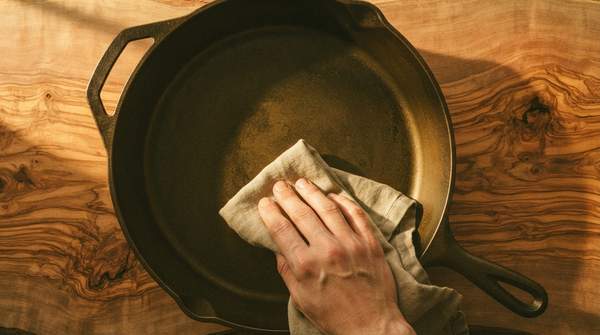
Prevention is simpler than repair, and the routine is short. Lodge's cleanup guidance: after cooking, wash your cast iron in warm, soapy water, dry it off completely, then add a very thin, even layer of oil and rub it in with a paper towel. The test for "thin enough" is concrete—when you tilt the skillet, the oil should not run or drip. Lodge warns that using too much oil at this step is exactly what makes cookware sticky.
That post-cook wipe is a light maintenance coat, not a full seasoning, but it feeds the same polymer layer every time you heat the pan. Beyond that, the main threats are the ones the diagnostic table already identified: never let the pan soak or air dry, never put it in the dishwasher, and store it somewhere dry. A small amount of rust is not a crisis—Lodge frames rust as fixable at home, and for small spots a scouring, a wash, thorough drying, and a wipe of oil may be enough.
Field Company adds a reassuring boundary to what counts as damage: cast iron's durability means it can be brought back from almost any condition. The only true loss, in their assessment, is a crack, which compromises structural integrity. Seasoning, by contrast, is always recoverable, because you can always strip down to bare metal and rebuild. This applies equally to skillets, Dutch ovens, and griddles—the chemistry of the surface does not care about the pan's shape. Note that this guide covers bare cast iron only; enameled cast iron has a glass coating and entirely different care needs.
Achieving Durable Seasoning: A Continuous Process
The decision this framework equips you to make: regularly inspect your cast iron cookware for signs of seasoning degradation and apply corrective actions based on the underlying chemical causes to maintain optimal non-stick performance and prevent rust. You are not chasing a one-time factory finish; you are managing an ongoing reaction between fat, heat, and iron, and every wash-and-oil cycle either feeds it or neglects it.
The measurable indicator that your approach is working is a consistently smooth, hard, dark, and non-sticky surface on your cast iron cookware. When you tilt a freshly oiled pan and nothing drips, when the surface feels slick rather than tacky, and when no orange bloom appears after a damp week, the polymer layer is doing its job. When any of those checks fails, the diagnostic table tells you which link in the chemical chain broke and how to restore it.
Sources
- Periodic Graphics: The chemistry of cast-iron cookware — Chemical & Engineering News
- Chemistry of Cast Iron Seasoning: A Science-Based How-To — Sherylcanter
- How to Fix Common Cast Iron Concerns — Lodge Cast Iron
- Visual Guide to Cast Iron Care — Field Company