Most sourdough starter problems announce themselves before they become serious: a starter that barely bubbles, a jar that smells like nail polish remover, a dark liquid pooling on top. Bakers often fear the worst, but the encouraging truth, echoed across expert troubleshooting guides, is that the majority of these symptoms trace back to just three variables — temperature, feeding routine, and flour — and most can be corrected with a simple adjustment. This guide walks you through a diagnostic framework that matches what you see and smell to a likely cause and a concrete fix, and it draws a clear line between a starter that needs help and one that must be thrown out.
Introduction: Understanding Your Sourdough Starter’s Health
A sourdough starter is a living culture of wild yeast and lactic acid bacteria, and like any living thing, it communicates its condition. “Did I kill my starter?” is, in the words of King Arthur Baking’s Barb Alpern, a surprisingly common question to their Baker’s Hotline — novice and experienced bakers alike worry about their starter’s viability. Part of that anxiety comes from the fact that the biochemistry inside the jar remains a mystery to many home bakers.
The good news is that you do not need to understand the microbiology to read the signals. Starters fail in recognizable patterns, and bakers who maintain cultures for years have mapped those patterns well. Before you panic, know two things: cool conditions and missed feedings are the most frequent culprits behind sluggishness, and a healthy culture is more resilient than it looks. This article focuses on troubleshooting an existing wheat or rye starter, not on creating one from scratch, and gluten-free starters follow different rules entirely.
Sourdough Starter Diagnostic Framework
Work through this matrix by observing your starter directly — look at its surface, its rise after feeding, and any liquid, and take note of its aroma before stirring. Match what you find to a row and apply the corresponding fix. Note that a larger feeding is not a universal cure; the starter’s actual condition should be verified first, as Living Dough’s troubleshooting guidance cautions.
| Symptom | Likely Cause | Recommended Solution |
|---|---|---|
| Sluggish rise; few bubbles; slow progress through normal fermentation signs | Cool ambient temperature slowing fermentation — even 70°F (21°C) can do it — or insufficient food | Keep it warm, around 74–76°F (23–24°C), and feed adequately; expect an uptick in activity and, in Maurizio Leo’s experience, flavor |
| No visible bubbles after neglect | Underfed culture with nothing to ferment | Feed it and give it time before discarding anything — the bubbles are the “leaves” of this houseplant |
| Pungent smell of acetone, alcohol, vinegar, or beer | Hungry starter; yeast digested the available flour and produced alcohol, with acetone possibly signaling a problem | Feed promptly and increase feeding frequency; aromas shift through stages of the feeding cycle and should normalize |
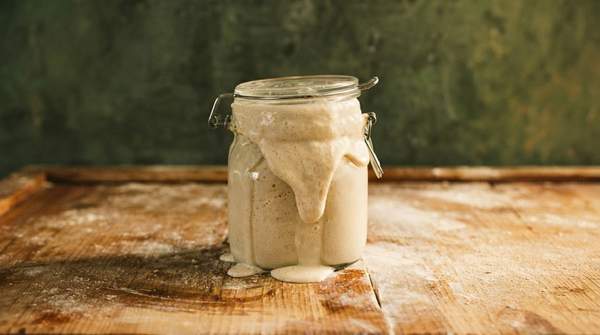
| Dark or clear liquid layer, pourable like water, on top | Hooch — a byproduct of exhausted food supply, not spoilage | Pour off or stir it in, then feed immediately; a vinegar smell alongside it is still safe |
| Fuzzy white, pink, green, or blue spots, or growth on jar sides; pink or orange streaks | Mold contamination | Discard the entire starter and start fresh; sanitize the jar with bleach solution (1 tbsp per gallon of water) or boil for 10 minutes |
The heart of the framework is simple: pourable liquid is hooch and safe; fuzzy or colored growth is mold and is not. Practitioner guidance collected by Flourwise’s Mariusz Lasak reduces it to a single test — if you can pour it like water, it is hooch and safe to feed.
Mastering the Variables: Temperature, Feeding, and Flour
Temperature is the lever most beginners overlook. Maurizio Leo of The Perfect Loaf is emphatic that it matters most: a starter kept at a low temperature, even 70°F (21°C), will slow fermentation activity and appear sluggish, taking longer to rise and to move through the typical signs of fermentation. His solution is warmth — around 74–76°F (23–24°C) — which reliably produces an uptick in activity and, in his experience, better flavor.
Feeding is the second control. Yeast digests flour and produces alcohol and carbon dioxide, along with many flavor compounds, so an alcohol aroma alone is not unusual — but it intensifies as food runs out, and acetone in particular, as sourdoughhome’s guidance puts it, “can be a sign that there problems.” A missed feeding here or there will not kill a well-kept starter, the same source reassures, comparing it to a healthy person skipping a meal. Tom Cucuzza of The Sourdough Journey teaches that a fed starter moves through stages with shifting aromas; learning where your starter sits in that cycle tells you whether a smell is a red flag or just a sign it is ready to eat.
Flour choice shapes the whole system, since it is the starter’s only food. Whole-grain and rye flours carry more of the nutrients and microbial diversity that drive vigorous fermentation than refined white flour does. Notably, Living Dough warns not to judge color in a chocolate starter by pale-mixture standards — compare any starter to its own usual appearance rather than a generic ideal.
When to Discard: Recognizing Irreparable Spoilage
Very few situations truly end a starter’s life, and it helps to name them precisely. Fuzzy mold — white, pink, green, or blue spots, or growth on the jar’s sides — means the culture is contaminated and cannot be saved by scraping off the surface. Living Dough’s troubleshooting guidance extends the same verdict to unexpected pink or orange streaks and other signs of contamination: discard the starter, clean the container, and start again. Do not taste suspect starter.
Everything else is generally recoverable. Hooch — whether dark, gray-brown, or clear with a strong alcohol note — indicates nothing worse than hunger, and flour practitioners consistently classify it as safe. Pour it off or stir it in and feed normally. If a starter’s condition is genuinely uncertain, the prudent move is to pause using it and seek guidance rather than guessing.
Restoring Your Starter: A Path to Consistent Baking
The path forward is a loop, not a rescue mission. Regularly assess your sourdough starter’s activity, smell, and appearance against the diagnostic framework so you can proactively address issues and maintain a robust culture for baking. That is the decision this guide supports: observe first, adjust one variable at a time, and reserve the trash can for mold and pink-orange streaks alone.
Your checkable indicator is sourdough starter activity, aroma, and texture. When you feed a warm, adequately nourished starter, those three should move together toward a familiar state: steady bubbling, a clean sour aroma rather than harsh acetone, and a texture that rises predictably. Judge any starter against its own history — every culture’s microbiome is unique, and results vary with local conditions. A starter whose smell, rise, and texture return to their established pattern after a temperature and feeding adjustment is a starter ready to bake.
Sources
- Sourdough starter troubleshooting — King Arthur Baking
- Sourdough Starter Troubleshooting — Living Dough
- 21 Common Sourdough Starter Problems with Solutions — The Perfect Loaf
- My Starter Smells Like Nail Polish. Should I Throw It Out? — Flourwise
- What Should Sourdough Starter Smell Like? — Sourdoughhome
- FAQ - Starter Troubleshooting — THE SOURDOUGH JOURNEY