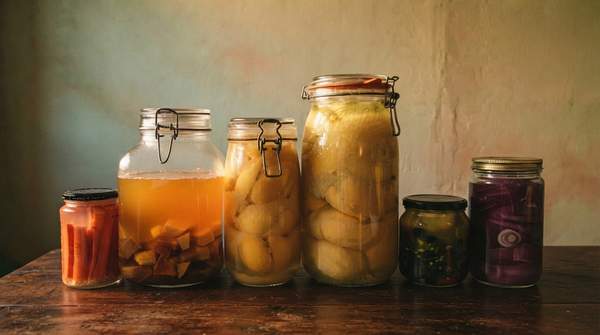
When you pack cabbage into a jar and wait, you are not simply letting food spoil slowly. You are hosting a relay race of bacteria, each group taking the baton as conditions change, converting natural vegetable sugars into acids, gases, and alcohol. The end result is a food that resists spoilage and tastes distinctly sour and complex. Understanding this sequence is what separates anxious fermenters from confident ones, because every bubble and tang in your jar maps to a specific microbial event.
Stage 1: Setting the Scene for Lactic Acid Bacteria
Fermentation begins with the vegetables themselves. Every cabbage leaf, cucumber, and carrot carries natural sugars, and those sugars are the fuel for the entire process. According to Virginia Cooperative Extension's guide to vegetable fermentation, the most important fermenters belong to the lactic acid bacteria family — specifically Leuconostoc, Lactobacillus, and Pediococcus species. These microbes are already present on the vegetables and in the surrounding environment, which is why wild fermentation requires no added cultures.
What you do at the start is less about adding anything and more about shaping the environment. An anaerobic — oxygen-free — setting encourages the growth of lactic acid bacteria strains, as a review of industrial fermentation in the food industry explains. That is the practical logic behind submerging vegetables beneath brine: you are choosing which microbes get to work. Salt plays a supporting role here, drawing water out of the vegetables to form brine and helping favor the salt-tolerant lactics over spoilage organisms. The stage is set the moment your vegetables are fully submerged and oxygen is excluded.
At this early point, the jar may seem quiet, but the microbial population is already shifting. The conditions you created — no oxygen, salt, and abundant sugar — determine which bacteria can multiply and which cannot. Everything that follows flows from this selective setup.
Stage 2: The Rise of Heterofermentative LAB and Flavor Development
The first major fermenters to dominate are the heterofermentative lactic acid bacteria, and Leuconostoc mesenteroides is the classic example. The Virginia Extension guide describes how, in the sequential growth observed in sauerkraut, Leuconostoc becomes dominant as the pH begins to drop. These bacteria are generous chemists: rather than producing a single compound, they generate a whole portfolio of byproducts from the vegetable sugars.
That portfolio includes lactic acid, acetic acid, ethanol, and carbon dioxide. Each contributes something you can observe or taste. The carbon dioxide is what you see as bubbles rising in the brine — the visible signature of active fermentation. The acids begin lowering the pH of the environment, and the ethanol and acids together contribute to the characteristic flavor and aroma of the ferment. This is why the early stage of a ferment matters so much for taste: the compounds that make your sauerkraut interesting, not merely sour, are largely laid down by these early heterofermentative workers.
This stage is also self-limiting in an elegant way. As Leuconostoc produces acid, it gradually makes the environment less hospitable to itself. The very acids that create flavor also lower the pH past the point where these early fermenters thrive. They have, in effect, prepared the environment for their successors — and done the flavor work that those successors cannot replicate.
Stage 3: Homofermentative LAB and Final Preservation
As acidity continues to increase, acid-tolerant bacteria take over. The Virginia Extension guide identifies Lactobacillus plantarum and Pediococcus species as the dominant organisms in the final stage of fermentation. These are homofermentative lactic acid bacteria, and their approach is more focused than that of their predecessors: where other fermenting organisms produce many end products, these bacteria produce primarily acid.
This single-minded acid production is what completes the preservation. The final pH of fermented vegetables typically ranges from 3.5 to 4.0, according to the Extension material, and that level of acidity inhibits most spoilage microorganisms and pathogens. Lactic acid itself acts as a natural preservative, extending the product's shelf life, as the fermentation overview notes. In other words, the same compound that gives fermented vegetables their sourness is the compound that keeps them safe to eat for months.
The relay is complete when the acid-tolerant lactics have pushed the pH to its final range and the available sugars are largely consumed. What remains is a stable, acidic environment that spoilage microbes cannot easily colonize — a vegetable transformed by a sequence of bacteria that each did one job and handed off to the next.
The Sequential Stages of Vegetable Fermentation
The table below maps the microbial succession described in sauerkraut fermentation onto the chemical changes and observable signs in your jar. Use it to identify where your own ferment stands: active bubbling signals the heterofermentative stage, while a stable, sharply sour flavor signals the homofermentative finish.
| Stage | Dominant Microorganisms | Key Byproducts | Resulting Environment |
|---|---|---|---|
| Primary fermentation | Leuconostoc mesenteroides becomes dominant as pH drops | Lactic acid, acetic acid, ethanol, and carbon dioxide from natural vegetable sugars | Rising acidity; visible CO2 bubbling; early flavor and aroma compounds form |
| Final stage | Acid-tolerant Lactobacillus plantarum and Pediococcus species take over as acidity further increases | Primarily lactic acid | Final pH typically 3.5 to 4.0, inhibiting most spoilage organisms and pathogens |
Reading the table as a timeline rather than a menu is the key insight. Each stage creates the conditions for the next: the heterofermentative bacteria acidify the environment enough to suppress themselves and invite the acid-tolerant lactics, which then drive the pH down to its final preservative range. The byproducts column also explains why flavor develops in layers — the early stage contributes the aromatic complexity, while the final stage contributes the clean, sharp sourness and the preservation itself.
Managing Your Ferments: Observing the Science in Action
Home cooks can confidently manage their vegetable ferments by understanding the sequential microbial stages and controlling key environmental factors. Your job is not to micromanage the bacteria but to hold the conditions steady: keep the vegetables anaerobic under brine, maintain a consistent temperature, and let the succession run its course rather than judging the ferment by its early smell alone.
The measurable indicator of success is straightforward: consistent bubbling, a gradual decrease in pH, and the development of characteristic sour flavors indicate successful lactic acid fermentation. When those three signs align — bubbles from the heterofermentative stage, rising acidity from the homofermentative stage, and the sour flavor of lactic acid — you are watching the same bacterial relay that food scientists document in sauerkraut, playing out on your countertop.