For millennia, long before refrigeration or canning, humanity relied on a mysterious and powerful process to preserve food: fermentation. This ancient technique, which transforms perishable goods like milk, vegetables, and grains into staples with extended shelf lives and unique flavors, was practiced globally without any scientific understanding of the microscopic forces at work. At its core, fermentation was a practical, life-sustaining solution to the fundamental challenge of storing seasonal harvests and ensuring a stable food supply through lean times. It represents one of civilization's earliest forays into biotechnology, born from observation and necessity.
The Three Stages of Fermentation Understanding
The human relationship with fermentation has evolved over thousands of years, a journey that can be understood in three distinct stages. This progression tracks our understanding from the passive observation of a natural phenomenon to the deliberate control and optimization of a powerful biological process. This framework helps clarify how the "why" behind the practice changed as knowledge grew.
Ancient Practice: An Observed Phenomenon
The earliest encounters with fermentation were likely accidental. For millennia, people used this process without fully understanding its mechanics, relying on trial and error to create staples like bread, beer, and cheese. One historical account suggests the first yogurts may have formed unintentionally in goat bags carried on the backs of camels, where the heat of the North African desert created ideal conditions for milk to transform. Early humans would have observed that under certain conditions, some foods "spoiled" in a way that made them not only safe to eat but also resistant to further decay. This was empirical science at its most fundamental: a reliance on observable outcomes to develop practices that worked, even if the underlying cause remained a complete mystery.
Traditional Application: Intentional Preservation
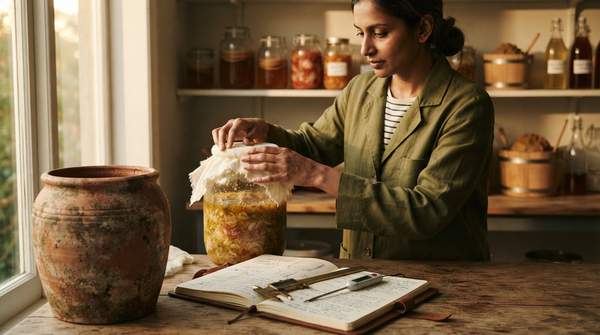
Over centuries, these accidental discoveries were refined into deliberate and reliable techniques passed down through generations. Fermentation became a cornerstone of food preservation, a way to store a garden harvest or keep milk from spoiling long before its nutritional value was lost. As described by the Living History Farms museum, in the early 20th century, fermentation was primarily understood as a method to store food without the need for refrigeration. This "inherited wisdom," as a 2021 article in the journal Metabolites describes it, allowed diverse cultures to select the right ingredients and create the proper conditions to produce safe, healthy, and flavorful foods. This led to a rich global tapestry of fermented products, from sauerkraut and kimchi in Europe and Asia to sourdough and kefir, each adapted to local climates and available crops.
Modern Understanding: Scientific Control
It was not until the 19th century that the mystery behind fermentation was finally solved. In the 1850s, French chemist Louis Pasteur conducted groundbreaking research demonstrating that microorganisms like yeast and bacteria were responsible for the process. According to the food technology company Verley Food, Pasteur's work transformed fermentation "from an art into a science." He identified two primary types of fermentation—alcoholic, driven by yeast, and lactic acid, driven by bacteria. This discovery laid the foundation for the fields of microbiology and biotechnology, allowing for controlled, efficient, and safe food production on an industrial scale. This scientific insight represents the latest stage in fermentation's long history, moving from empirical practice to full scientific understanding and control.
Transforming Perishable Harvests: A Global Pantry
The primary historical role of fermentation was to convert highly perishable raw materials into stable, long-lasting foods. This transformative power was applied across a wide range of food categories, creating a global pantry of products that remain central to many cuisines today. The process was a direct response to the natural cycles of glut and scarcity. Milk, for example, is incredibly nutritious but spoils quickly. Through the action of lactic acid bacteria, it can be turned into durable products like cheese, yogurt, and kefir. This preserves the milk's vital calories and nutrients for weeks or months, a critical advantage for early pastoral societies.
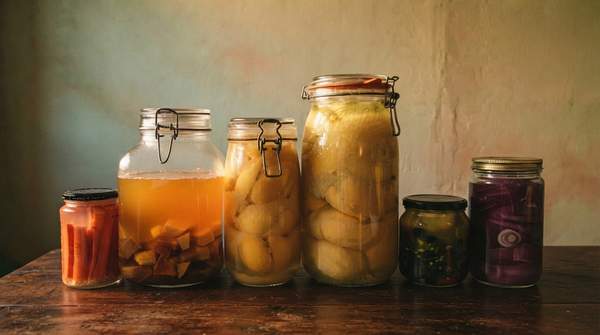
Vegetables and fruits from a seasonal harvest presented a similar challenge: an abundance of food that would rot if not consumed or preserved. Fermentation provided a simple and effective solution. By submerging vegetables like cabbage in a brine, an anaerobic (airless) environment is created, allowing beneficial bacteria to thrive and produce lactic acid, which acts as a natural preservative. This is the basic principle behind German sauerkraut and the spicy Korean staple, kimchi. This technique allowed communities to enjoy the benefits of their garden harvest throughout the year. Grains, while more stable than fresh produce, were also transformed by fermentation.
The action of yeast on flour causes bread to rise by producing carbon dioxide gas. The same microorganisms, when applied to cereal grains in a liquid mash, convert sugars into alcohol, resulting in beer. These processes not only preserve the grains' caloric value but also make them more digestible and create entirely new culinary experiences.
The Unseen Architects: Microbes at Work
Long before Pasteur revealed their existence, microscopic organisms were the silent partners in every successful fermentation. The basic principle of food preservation through fermentation relies on manipulating environments to encourage the growth of beneficial microbes while discouraging those that cause spoilage or disease. The process is fundamentally anaerobic, meaning it occurs in an environment without oxygen. In general, fermentation involves microorganisms like bacteria, yeast, and molds breaking down complex organic compounds, such as sugars and starches, into simpler substances like acids, gases, or alcohol. This chemical transformation is what gives fermented foods their characteristic tangy flavors and aromas.
Pasteur's identification of alcoholic and lactic acid fermentations provided the first scientific classification for these processes. In alcoholic fermentation, yeasts consume sugar and produce ethyl alcohol and carbon dioxide—the basis for beer, wine, and leavened bread. In lactic acid fermentation, bacteria convert sugars into lactic acid. This acid lowers the pH of the food, creating an environment where harmful, spoilage-causing microbes cannot survive. This is the primary mechanism that preserves foods like yogurt, kimchi, sauerkraut, and fermented sausages.
Embracing Fermentation's Enduring Value
From its accidental origins in ancient history to its modern applications in biotechnology, fermentation has been an integral part of human civilization. The work of Louis Pasteur demystified the process, revealing the microbial action that our ancestors had harnessed through observation and tradition for thousands of years. Today, advanced scientific tools continue to deepen our understanding of these complex microbial ecosystems, affirming what researchers in Metabolites called the "inherited wisdom of ancient societies." By understanding this long and rich history, we can recognize fermentation not just as a culinary trend, but as a fundamental, evolving technology that has shaped human civilization and continues to offer benefits.
This perspective fosters an increased appreciation for the historical context and scientific principles behind the fermented foods that enrich our diets and cultures, connecting our modern kitchens to an ancient and global human story of survival, ingenuity, and flavor.