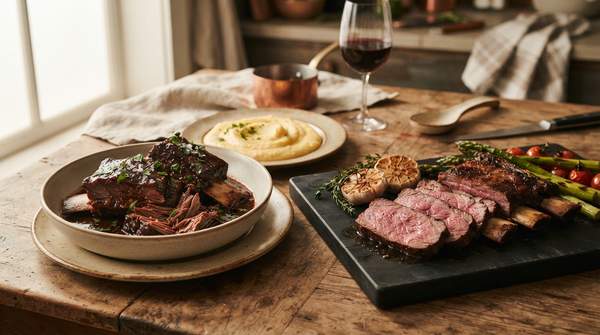
Short ribs give you two very different destinations from the same cut of meat. Braise them low and slow in the oven, and you get the classic falling-off-the-bone tenderness that made the cut famous. Cook them sous-vide, and you can either replicate that braised texture or do something an oven cannot: produce a short rib with the juicy, steak-like bite of a prime rib. The method you choose comes down to your schedule, your equipment, and the texture you're craving — and the cut you buy matters just as much.
Understanding Short Rib Cuts: English-Style vs. Flanken-Style
Before you pick a recipe, pick the right cut, because the two styles you'll see at the butcher counter are built for entirely different jobs. Mark Gronowski's short rib guide for Acabonac Farms describes English-cut ribs as thick, meaty ribs that run lengthwise along the bone. That thickness makes them top-notch for slow-cooking methods like braising or roasting, where collagen breaks down over time into fork-tender bites with big, beefy flavor.
Flanken-cut ribs are the opposite: sliced thin across the bone, so each strip contains multiple small bone sections. You'll see them in Korean barbecue, sometimes called "LA galbi," and they're meant for quick cooking over a hot grill or under the broiler — not for the slow methods this comparison covers.
There's a third layer of detail worth knowing. Fred Decker, writing for Tasting Table, notes that store-bought short ribs can come from three areas: chuck ribs from the shoulder, back ribs attached to rib roasts, and plate short ribs from around the steer's belly. All three are tough and need slow cooking, but plate ribs are thick and meatier, like the neighboring brisket, while back ribs usually carry less meat. For slow cooking, thick and meaty is what you want.
Braising Short Ribs: The Classic Fall-Apart Tender Method
Braising is the most traditional preparation and, according to Snake River Farms, one of the most popular for good reason. The method uses low heat and liquid to slowly break down connective tissue. The guidance from their test kitchen is specific: braise short ribs in the oven or on the stovetop at 275°F to 300°F for about 2.5 to 3 hours.
Why does time matter so much? Snake River Farms explains that collagen needs time to convert into gelatin, and rushing the process results in tough meat. Acabonac Farms echoes the principle: short ribs become more tender the longer they cook, as heat breaks down the tough connective tissue. That transformation is what delivers the succulent, falling-off-the-bone-tender texture braising is known for.
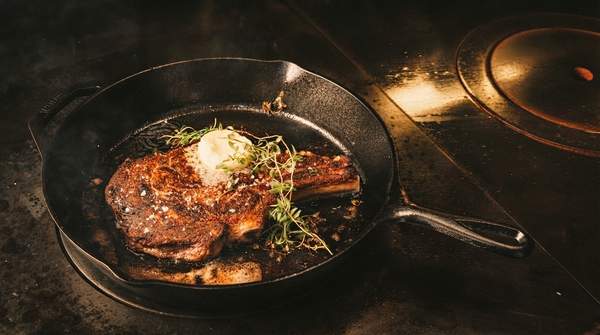
The technique itself is straightforward. Snake River Farms recommends patting the ribs dry, seasoning generously with salt and black pepper, and searing them in a heavy Dutch oven until deeply browned on all sides before the long, gentle simmer. The equipment bar is low — a Dutch oven and an oven — which is part of why braising remains the default for home cooks.
Sous-Vide Short Ribs: Precision for Varied Textures
Sous-vide changes the equation entirely. Instead of an oven's ambient heat, you cook sealed ribs in a precisely controlled water bath, and that precision lets you choose your texture deliberately. This method allows for replicating the tender texture of braising or achieving a steak-like tenderness, depending on the time and temperature selected. As Fred Decker notes for Tasting Table, short ribs are one of the best cuts for sous-vide cooking.
The numbers come from practitioners who have tested both endpoints. Stefan of Stefan's Gourmet Blog lays out the two poles directly: for braised, unctuous ribs, cook sous-vide for 24 hours at 74°C/165°F; for juicy, tender ribs with the texture of steak or prime rib, go for 48 hours at 57°C/135F — a pairing he says he determined through his own testing.
The Institute of Culinary Education's taste-test writeup frames the same decision as a planning problem. Cooking times for tough, usually braised cuts can range anywhere from 12 to 72 hours depending on the temperature selected, and temperatures can be adjusted to fit the time you have. Their rule of thumb: if food needs to be ready in 24 hours or less, it must be cooked at 66°C or higher. In other words, the steak-like result is the slower, lower-temperature path, while the braised-style result can arrive on a tighter clock.
Short Rib Cooking Methods: Braising vs. Sous-Vide
Here is the side-by-side decision guide for English-cut short ribs, built from the time, temperature, and texture guidance above. Read it as a map of trade-offs: braising reliably delivers the classic result in a single afternoon, while sous-vide buys you a texture choice braising can't offer, at the cost of a longer clock and immersion equipment.
| Dimension | Braising | Sous-Vide |
|---|---|---|
| Cooking method | Low, moist oven or stovetop heat, typically 275°F to 300°F | Precise water bath; temperature set to the desired texture |
| Typical cut | English-cut, thick and meaty along the bone | English-cut; among the best cuts for sous-vide |
| Total time | About 2.5 to 3 hours | 12 to 72 hours; 24 hours at 74°C/165°F for braised-style, 48 hours at 57°C/135°F for steak-like |
| Resulting texture | Falling-off-the-bone tender as collagen converts to gelatin | Your choice: braised-style tenderness or a juicy, steak-like bite |
| Best for (flavor profile) | Classic red wine and herb braises, hearty stews | Any of those profiles, plus clean seasoning for steak-like serving |
The pattern to notice: the two methods converge on the fall-apart texture — sous-vide simply takes longer to get there — but they diverge completely on the steak-like option, which only the water bath can produce. Times are estimates and can vary with your equipment and the specific cut of meat.
Crafting Flavor Profiles for Slow-Cooked Short Ribs
Once you've chosen a method, the flavor architecture is remarkably flexible. As Snake River Farms puts it, "Short ribs are also one of the most adaptable cuts we work with. They pair just as naturally with red wine and herbs as they do with soy, ginger, garlic, and sesame."
That adaptability maps onto three representative directions. The classic route is red wine and herbs — the foundation of most traditional braises, where the seared ribs simmer in wine and aromatics until the sauce reduces into something rich and savory. A second direction leans on beer and hearty stew ingredients, the kind of rich, aromatic combinations braising handles so well. The third goes modern and Asian-inspired: soy, ginger, garlic, and sesame, the profile that made flanken-cut LA galbi famous and works just as well on slow-cooked English ribs.
Acabonac Farms notes that this range is exactly why the cut has climbed the culinary ranks, appearing everywhere from Korean barbecue spreads to hearty Mexican stews to holiday tables. These are representative examples rather than an exhaustive catalog — but they show how the same slow-cooking technique can carry completely different cuisines.
Making Your Short Rib Decision
Choose your short rib cut and cooking method based on your desired final texture and available time, prioritizing English-cut for slow-cooking methods like braising or sous-vide, and Flanken-cut for quicker grilling. If you want the familiar braise and own a Dutch oven, braise at 275°F to 300°F for roughly 2.5 to 3 hours. If you want the steak-like texture only sous-vide can deliver, plan for 48 hours at 57°C/135°F; if you want braised-style tenderness from the water bath, 24 hours at 74°C/165°F is the tested pairing.
You'll know you chose well by a simple measurable indicator: the short ribs achieve the desired fall-off-the-bone or steak-like texture, and the chosen flavor profile — whether red wine and herbs or soy, ginger, and sesame — is well-integrated into the tender meat. That's the outcome to check before you plate, and the reason the cut-and-method decision deserves a few minutes of thought before you buy.
Sources
- Beef Short Rib Guide — Acabonac Farms
- 11 Mistakes To Avoid When Cooking Short Ribs, According To A Trained Chef - Tasting Table
- Beef Short Ribs Sous-Vide: Like Steak Or Braised — Stefan's Gourmet Blog
- Taste Test: Short Ribs — ICE
- How to Cook Beef Short Ribs: Braised, Smoked, Oven & Slow Cooker — Snake River Farms