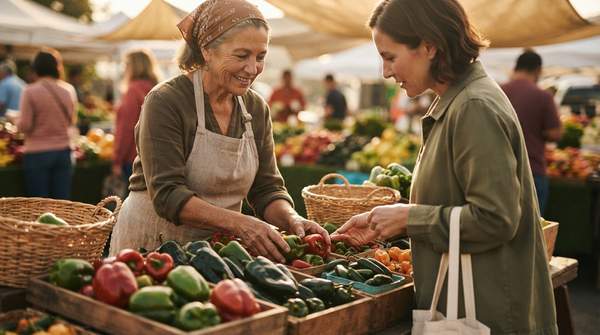
Peak pepper season turns market stalls into a rainbow of glossy green, red, yellow, orange, and deep purple fruits, each with its own personality. The practical question for a home cook is simple: which one do you buy for tonight's dish? The answer comes down to heat, measured in Scoville Heat Units (SHU), and flavor. Here is how to read the baskets like a pro.
Navigating the Farmer's Market Pepper Selection
Journalist Annaliese Keller, writing for Edible Paradise, captures the scene well: at peak season, "you'll find sweet bell peppers for salads and sautés, smoky poblanos for roasting, shishitos and padróns for blistering in a hot skillet, and plenty of chilies for salsas, sauces, pickling, and homemade hot sauce." Peppers, she notes, "can be sweet, grassy, fruity, smoky, floral, or fiery — sometimes all in the same family."
That range is why a heat scale matters. The Scoville scale ranks peppers by their concentration of capsaicin, the compound that burns. Pepper Joe's, a pepper nursery publishing a heat chart by Alana Smith, organizes varieties into bands: bell and pimento peppers sit at 0–100 SHU, jalapeños land in the low thousands, and habaneros climb into the hundreds of thousands. Knowing a pepper's approximate band tells you, before you taste it, whether it will whisper or shout in your dish.
Two cautions apply before you shop. First, these figures are typical ranges, not guarantees — individual peppers vary within a variety. Second, sources sometimes disagree on where a pepper sits, as we'll see with Anaheim and poblano. When that happens, it's wise to treat the lower figure as your floor and the higher as your ceiling, and to taste a sliver before committing a whole pepper to a delicate dish.
Pepper Varieties: Heat, Flavor, and Culinary Uses
Start with the anchors. The poblano is a useful reference point because PepperScale's Matt Bray positions it precisely: "If you're looking for a heat roughly halfway between a zero-heat bell pepper and a jalapeño, the poblano is a very good match." Poblanos range from 1,000 to 1,500 SHU, making them two to eight times milder than a jalapeño, which he places at 2,500 to 8,000 SHU. Against cayenne (30,000 to 50,000 SHU), poblanos are "more of a hint of heat rather than a fiery contender."
Roasting transforms the poblano. Its earthy, mild character pairs naturally with creamy Mexican cheeses like queso fresco, brightened by lime and cilantro — the classic combination in chiles rellenos and stuffed-pepper dishes. The Anaheim is its close cousin: Bill Hageman's growing guide for Grow Organic describes it as having "a mild heat with a slight sweetness" and notes it "can develop a gentle smoky flavor when roasted." Gardeners, he writes, often compare Anaheim and poblano "because both are great for roasting, but poblanos are wider and meatier" — which is why poblanos win for stuffing and Anaheims work well as a substitute when you want thinner walls.
Step up the ladder and the character changes. Pepper Joe's chart places jalapeños at 2,500–5,000 SHU and serranos at 5,000–15,000 SHU, in the "mild–medium" band — meaning a serrano can run several times hotter than a mild jalapeño, so it earns respect in salsas. At the top of the common market range sit habaneros at 100,000–350,000 SHU, firmly in the "hot" category, a level best treated as a seasoning rather than a vegetable.
Pepper Comparison for Home Cooks
The table below synthesizes heat figures and flavor descriptions from these sources into one quick reference. Use it to match a pepper to your desired heat and recipe before you buy.
| Pepper | SHU Range | Flavor Profile | Best Culinary Uses |
|---|---|---|---|
| Bell | 0–100 | Sweet, no heat | Salads and sautés |
| Anaheim | 500–2,500 (one chart groups it at 1,000–2,500) | Mild heat, slight sweetness; gentle smokiness when roasted | Roasting; a poblano substitute when thinner walls are fine |
| Poblano | 1,000–1,500 (one chart groups it up to 2,500) | Mild, earthy; smoky when roasted | Roasting and stuffing; pairs with queso fresco, lime, cilantro |
| Jalapeño | 2,500–8,000 | Medium heat; broadly appealing, versatile kick | Adding moderate heat to everyday dishes |
| Serrano | 5,000–15,000 | Mild–medium heat, notably hotter than jalapeño | Salsas and sauces where punch is wanted |
| Habanero | 100,000–350,000 | Hot | Use sparingly as a heat source, not a bulk vegetable |
Note where sources diverge: Grow Organic puts Anaheim at roughly 500–2,500 SHU, while Pepper Joe's chart lumps Anaheim with poblano in a 1,000–2,500 band. PepperScale's dedicated poblano page is more precise at 1,000–1,500. And on jalapeños, PepperScale says 2,500–8,000 while Pepper Joe's caps the band at 5,000 — a real difference worth knowing if you're heat-sensitive. This guide covers common market varieties, not every pepper you might encounter.
Making Your Pepper Choice and Handling Them Safely
The decision logic is straightforward. Want crunch and sweetness with zero burn? Bell peppers. Want a roasting pepper with body for stuffing? Poblano. Roasting with a gentler, sweeter profile? Anaheim. A controllable kick for cooking? Jalapeño, stepping up to serrano for salsa heat — and habanero only when a little goes a long way.
Because the heat lives in capsaicin, take care when preparing the hotter varieties: the goal is to enjoy your purchase without capsaicin irritation on your hands or in your eyes. The market vendor can tell you which basket is which, and a quick sliver tasted raw tells you more than any chart.
Home cooks can confidently select peppers from the farmer's market based on their desired heat and flavor profiles, and safely prepare them for culinary use. Success is easy to measure: the reader successfully identifies and purchases appropriate peppers and avoids capsaicin irritation during preparation — with a dish whose heat lands exactly where they intended it.
Sources
- Peak Pepper Season at the Farmers Market — Edibleparadise
- Pepper Heat Scale Explained: Scoville Chart From Bell to Reaper — Pepper Joe’s
- Poblano Pepper Guide: Heat, Flavor, Pairings, And More — PepperScale
- Serrano Pepper, Anaheim & Poblano: Growing Guide at Home — Grow Organic