The secret to an impressive cheese board is not a longer shopping list—it is variety. Rather than grabbing four cheeses at random, choose one cheese from each of four categories: soft and creamy, firm and aged, bold and blue, and fresh and tangy. This one-cheese-per-category method guarantees a range of milk types, textures, and flavor intensities, and it works for any season. Below, each category comes with its defining characteristics, named examples drawn from cheesemongers and food editors, and seasonal accompaniments to complete the board.
Your Four-Cheese Board Decision Framework
The framework below organizes the selection process into four categories, so that every board you build covers the full spectrum of texture and intensity. Pick one cheese per row, then match accompaniments to the season.
| Category | Key Characteristics | Example Cheeses | Seasonal Pairings |
|---|---|---|---|
| Soft & Creamy | Rich, buttery, spreadable; smooth texture | Brie, Delice de Bourgogne, Rush Creek Reserve | Crackers or fresh crusty bread; sweet preserves such as cherry-cranberry or quince paste |
| Firm & Aged | Dense, sliceable, nutty and savory with concentrated flavor | Parmesan, Manchego, aged cheddar, Midnight Moon, Mimolette | Marcona almonds, seeded crackers, crusty bread |
| Bold & Blue | Pungent, assertive, veined with mold; the board's intensity anchor | Cashel Blue, Rogue River Blue | Quince paste or cherry-cranberry preserves; date and walnut cake |
| Fresh & Tangy | Bright, acidic, lactic; crumbly or soft | Goat cheese | Fresh fruit such as sliced Fuyu persimmons; olives for a savory counterpoint |
The logic is simple: the soft cheese delivers richness, the aged cheese delivers depth, the blue delivers punch, and the fresh cheese delivers brightness. Together they cover every texture a guest might want—spreadable, sliceable, crumbly—and every intensity from delicate to assertive.
Category 1: Soft & Creamy Cheeses
The soft category is where indulgence lives. These cheeses are defined by their creamy, spreadable texture, and they set the tone for the whole board. A standout example is Delice de Bourgogne, a French bloomy-rind triple-cream cow's milk cheese from Burgundy. America's Test Kitchen's deputy editor Megan Ginsberg calls it a go-to: with a fat content of around 75 percent, it is, in her words, "slightly tangy" and "irresistibly smooth, rich, and creamy."
That combination of richness and gentle tang is exactly what makes soft cheeses so versatile. Ginsberg notes that when left to temper, Delice de Bourgogne "spreads like a dream over crackers or fresh bread." Brie is the classic entry point in this category, and Rush Creek Reserve—named by Amanda Biddle of Striped Spatula in her fall board lineup—offers a similarly luxurious, spoonable experience. Whichever you choose, let the cheese sit at room temperature before serving; the texture transforms.
Pair soft, creamy cheeses with something sweet that can cut through the fat. Cherry-cranberry preserves or quince paste, both of which appear on Biddle's fall board, provide the acidity and fruitiness to balance all that butterfat. A neutral cracker or slice of fresh crusty bread lets the cheese itself shine.
Category 2: Firm & Aged Cheeses
Firm and aged cheeses are the workhorses of the board: dense, sliceable, and deeply savory. Biddle's fall board features Midnight Moon, an aged goat cheese with caramel notes, alongside Mimolette, the vivid orange French wheel with a toasty, nutty character. Parmesan, Manchego, and aged cheddar round out the category's familiar faces.
What unites them is concentration. Aging drives off moisture and intensifies flavor, producing crystalline textures and nutty, brothy depth. Midnight Moon is a particularly useful example because it bridges categories: it is aged like a firm cheese but retains the gentle tang of goat's milk, making it a bridge for guests who think they dislike goat cheese.
For accompaniments, reach for things that complement rather than compete. Marcona almonds and seeded crackers, both from Biddle's fall lineup, offer crunch and a mild sweetness that flatters nutty aged cheeses. A slice of crusty bread provides a neutral base. Because aged cheeses are already intense, save the sweeter preserves for the blue and soft categories.
Category 3: Bold & Blue Cheeses
Every board needs a cheese with conviction, and blue cheese is it. Biddle's selections include Cashel Blue, an Irish farmhouse blue, and Rogue River Blue, an Oregon raw-milk cheese wrapped in pear-soaked leaves. These are the cheeses that anchor the board's flavor range at the assertive end.
Blue cheeses vary widely in strength, so this is the category where a conversation with a cheesemonger pays off. Erika Kubick, the cheesemonger interviewed by Diana Valenzuela for Katie Couric Media, recommends finding a local cheese shop and building a relationship with the monger there, because the cheeses you can access depend heavily on where you live. A good monger can steer you toward a milder blue for a cautious crowd or a roaring one for enthusiasts.
Pairing follows a simple principle: sweetness tames intensity. Quince paste and cherry-cranberry preserves, both on Biddle's fall board, deliver the sugary counterweight that makes blue cheese sing. The Spanish date and walnut cake she suggests adds a dense, fruity element that stands up to the blue's punch.
Category 4: Fresh & Tangy Cheeses
The final category is the palate cleanser. Fresh goat cheese is the primary example: bright, acidic, and lactic, with a texture that can range from crumbly to softly spreadable. After the richness of a triple-cream and the intensity of a blue, a wedge of tangy chèvre resets the palate.
Seasonal fruit is the natural partner here. Biddle's fall board pairs cheeses with sliced Fuyu persimmons, whose honeyed crispness mirrors the cheese's freshness. In warmer months, fresh fruit serves the same role; the principle is to match the cheese's brightness with produce at its seasonal peak. Taggiasca olives, from the same board, offer a savory, briny counterpoint that keeps the tangy cheese from tasting one-note.
Because fresh cheeses are delicate, keep their accompaniments simple: fruit, a light drizzle of something sweet if you like, and a mild cracker. Let the season do the work.
Assembling the Board
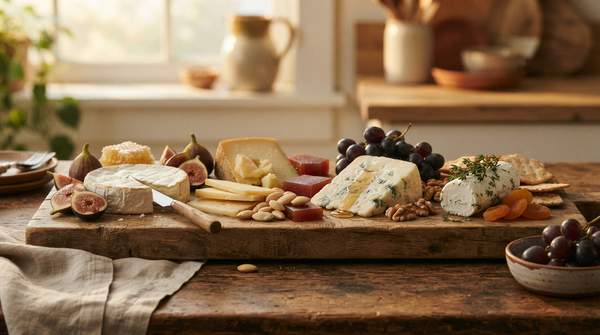
With one cheese from each category in hand, arrange them with space between, and place the accompaniments strategically: preserves near the blue, fruit near the fresh goat cheese, almonds and crackers near the aged wheels. Serve everything at room temperature, and let guests discover the contrasts you have built.
Crafting Your Next Seasonal Cheese Board
Confidently select a balanced variety of four artisan cheeses and pair them with intentional, seasonal accompaniments. The framework travels with you: one soft, one firm, one blue, one fresh, with the accompaniments rotating around whatever the season offers—persimmons, preserves, and Marcona almonds in autumn; fresh fruit and lighter pairings in summer. The measurable indicator of success is a visually appealing and flavorful cheese board that receives positive feedback from guests, demonstrating a thoughtful balance of textures, intensities, and seasonal elements. Start at your local cheese counter, ask the monger what is best this week, and fill your four categories from there.
Sources
- What Cheeses Should I Put on My Cheese Board? — America's Test Kitchen
- Fall Cheese and Charcuterie Board (4 Ready-to-Build Ideas) — Striped Spatula
- Slice, Serve, and Stun: How to Impress With Cheese Like a Pro — Katie Couric Media