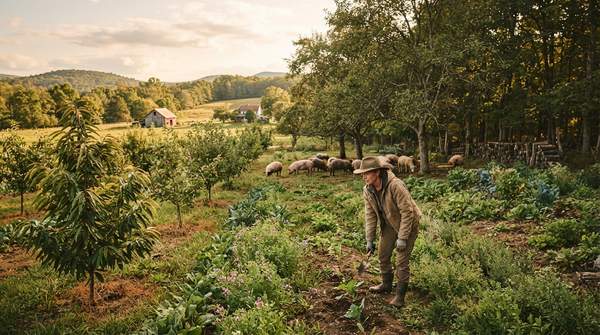
Agroforestry—the deliberate blending of trees and shrubs with crops, forage, and livestock—offers home gardeners and small-scale farmers three distinct paths to richer soil, greater biodiversity, and more resilient yields. The United States Department of Agriculture recognizes several agroforestry categories, but three "Agroforestry Farming Systems" dominate for anyone planning a working landscape: alley cropping, silvopasture, and forest farming. The right choice depends less on which is "best" and more on what your land already holds—an open field, grazing animals, or a stretch of woods—and what you hope to harvest from it.
What is Agroforestry for Small-Scale Farms and Home Gardens?
For a management practice to qualify as agroforestry, the USDA explains that it typically must satisfy four "i"s: it must be intentional, intensive, integrated, and interactive. In other words, simply letting a volunteer seedling linger at the edge of a vegetable bed does not count. Agroforestry means placing trees and shrubs into the farm's working fabric on purpose, managing them actively, and designing the whole so the parts interact—roots sharing soil, canopies moderating climate, animals cycling nutrients.
Done well, this integration serves several goals at once. The USDA frames agroforestry as a practice that enhances agricultural landscapes, watersheds, and communities, and the National Center for Appropriate Technology (NCAT) emphasizes that in temperate climates like the United States, agroforestry is fundamentally about "ways of arranging trees on working lands." For a small-scale grower, that arrangement is the heart of the matter: where the trees go, what grows beneath or beside them, and whether animals join the picture determine which of the three systems you are actually building.