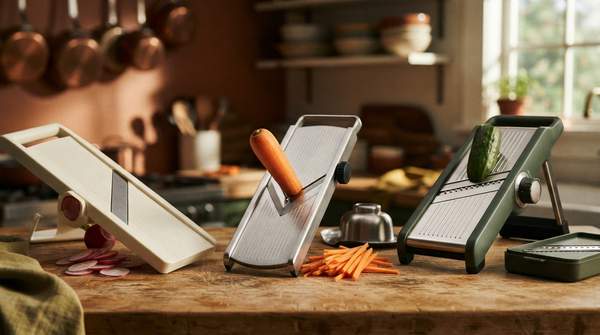
If you want paper-thin apple slices for a tart, a Japanese-style straight-blade mandoline is your tool. If you regularly slice big, round produce like sweet potatoes or soft tomatoes, a V-blade slicer will serve you better. And if you'd rather own one gadget that juliennes, grates, and chops as well as slices, a multi-function mandoline trades some specialized precision for versatility. That, in short, is the decision facing any home cook shopping for a mandoline—and it comes down to blade shape, adjustability, and how much counter and drawer space you can spare.
This guide covers manually operated mandolines for home use. It compares types and features rather than declaring a single "best" model, and it draws on hands-on testing from Epicurious and Wirecutter, along with expert commentary from kitchen retailers.
Japanese, V-Blade, and Multi-Function: Understanding Mandoline Types
Mandolines generally fall into a few recognizable styles. Wirecutter's testing guide, written by Daniela Galarza, distinguishes French, Japanese, and V-blade designs, and notes that you can choose either a simple handheld model for straight cuts or a mandoline with interchangeable blades that allow for julienne, dicing, french-fry, and even waffle cuts.
Japanese-style mandolines, such as the Benriner, feature a straight, exceptionally sharp blade. In Epicurious's testing, reviewers Wilder Davies and Alaina Chou found the Benriner's stepless thickness adjustment and thin, sharp blade made it their pick for experienced cooks seeking precision.
V-blade mandolines set the blade in a "V" shape, which helps guide produce through the cut. Harry Rosenblum, founder of The Brooklyn Kitchen, told Wirecutter: "The V-blade is great if you're dealing with a vegetable that's big and round." But that unique shape has limits—it may not accommodate all types of vegetables, and the stationary, bolted-in blades are usually not replaceable, so a dulled blade means a dulled tool.
Multi-function mandolines, like the Fullstar All-in-1 and the Mueller Austria Multi Blade, come with multiple interchangeable blades—five in both cases—plus thickness dials. The Fullstar also includes chopping inserts and a handheld spiralizer; the Mueller offers julienne and grating blades with thumb-dial thickness control. Their appeal is doing many jobs with one tool.
Mandoline Slicer Comparison for Home Cooks
The table below classifies the three main mandoline types by blade design and maps each to the tasks and produce textures it handles best, based on the testing and expert commentary described above.
| Mandoline Type | Best For (Cuts & Textures) | Key Feature | Primary Trade-off |
|---|---|---|---|
| Japanese-style (e.g., Benriner) | Paper-thin, consistent slices of firm produce like apples and radishes; delicate salad work | Straight, exceptionally sharp blade with stepless thickness adjustment | Precision-focused; less suited to very large or soft items |
| V-blade (e.g., Borner) | Large, round produce like sweet potatoes; soft, tender items such as tomatoes | V-shaped blade that guides food through the cut with less resistance | May not fit all vegetables; blades are usually stationary and not replaceable |
| Multi-function (e.g., Mueller, Fullstar) | Varied cuts—slicing, julienne, grating, chopping—in one tool | Multiple interchangeable blades plus a thickness dial | Bulkier; plastic construction may be less durable; blades may lack specialized sharpness |
Read the table as a decision aid: start with the produce you slice most often, then weigh the trade-off column against your storage space and how much precision you actually need.
Matching Mandoline Features to Your Kitchen Tasks
Blade sharpness and thickness adjustment matter more than any brand name. Epicurious tested mandolines against produce chosen to represent common use cases: fennel and cucumber for shaved salads, cabbage for slaw, apples for tarts, plus petite crispy radishes and big, starchy sweet potatoes to cover a range of sizes and textures.
For paper-thin apple slices, you need a blade that is both sharp and thin. Epicurious found the Oxo's blade wasn't quite as sharp as the Kyocera or Benriner, so while it powered through tougher vegetables with ease, it wasn't as adept at delicate apple work. Its adjustment dial also offered 0.5 mm increments that felt like big jumps compared with the Kyocera or the Benriner's stepless adjustment—though for most home cooks, the Oxo handled most tasks in an easy-to-use, safe-feeling way.
For soft and slippery produce, Wirecutter's testing is instructive: they required each blade to slice through the waxy skin, pithy fruit, and woody seeds of a lemon, the tricky skins of bell peppers, and soft, tender tomatoes, as well as everyday onions, carrots, and radishes. V-blade designs, per Rosenblum's guidance, are the natural fit for big, round items.
For specialty cuts—julienne for slaw, waffle cuts, french-fry cuts—look for interchangeable blades, which both Wirecutter and multi-function models like the Mueller and Fullstar offer. If your cooking rarely goes beyond straight slices, you can skip that complexity.
Essential Safety Features and Best Practices for Mandoline Use
Mandoline blades are exceptionally sharp by design, and safety deserves as much weight in your purchase decision as cutting performance. Wirecutter paid explicit attention to safety and ergonomics throughout testing, inviting several testers to use the mandolines alongside them, and every one of their picks features a rubber grip that keeps the tool stable while in use. A non-slip base or feet matter: a mandoline that slides on the counter is a mandoline that invites accidents.
Use the hand guard whenever one is included, especially for the final stretch of a vegetable, when fingers are closest to the blade. Multi-function models like the Fullstar advertise included safety features, but you should still read the manual carefully before first use—a point its own listing emphasizes. Cut-resistant gloves are a worthwhile addition for frequent users, though the evidence here supports their general use rather than any specific brand or type.
Blade changing and storage deserve care too. Interchangeable blades should be stored in their case or sheath, and note that V-blade models with bolted-in blades cannot be swapped or replaced—Wirecutter advises that if your current mandoline's blade has dulled and is not replaceable, that's a reason to consider upgrading. Never leave a bare blade loose in a drawer.
Making Your Mandoline Choice: Precision, Versatility, or Ease?
Home cooks should choose a mandoline based on their most frequent cutting tasks and the produce they commonly prepare—prioritizing ultra-thin precision (Japanese-style), efficient slicing of large or soft produce (V-blade), or broad versatility (multi-function)—while always insisting on robust safety features like a stable grip and a usable hand guard.
A practical way to decide: list the three dishes you'd actually make this month. If they lean toward shaved fennel salads and apple tarts, the sharp straight blade and stepless adjustment of a Japanese-style model will reward you. If sweet potatoes, tomatoes, and other big, round produce dominate, a V-blade will glide where a straight blade crushes. If you want julienne, grating, and chopping from one purchase and can accept a bulkier plastic body, a multi-function mandoline earns its drawer space.
Whatever you choose, you'll know the decision is sound when you can articulate the trade-off you accepted—precision versus reach versus versatility—and when your first batch of evenly sliced vegetables comes off the blade without a single close call.
Sources
- The Best Mandoline Slicer for Cutting Paper-Thin Vegetables (Not Your Fingers) — Epicurious
- The Best Mandoline — Wirecutter: Reviews for the Real World