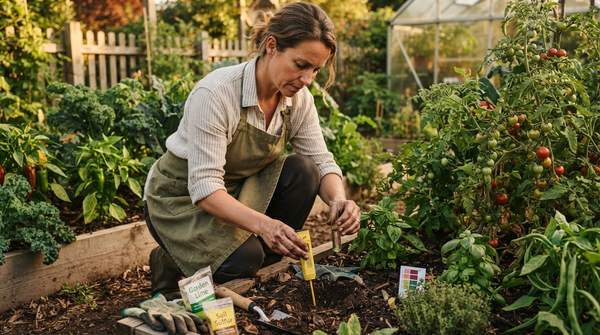
Yellowing leaves, stunted growth, and harvests that fall short of the seed catalog's promise often trace back to a single, invisible culprit: soil pH. The good news is that this is one of the most fixable problems in the garden. Most vegetables perform best when the soil sits slightly acidic to near neutral—Clemson University's Home & Garden Information Center cites pH 5.8 to 6.5 as best for most vegetables and ornamentals, while University of Florida IFAS extension specialists note a range of 5.5 to 7.0 suits most vegetable crops. If your soil test falls outside that window, you raise it with lime or lower it with elemental sulfur, and how much your soil resists that change depends on whether you garden in sand or clay. This article walks you through that decision, step by step.
Understanding Soil pH for Vegetable Gardens
Soil pH is simply a measure of acidity or alkalinity on a scale from 0 to 14, with 7 as neutral. Values below 7 indicate acidic soil; values above 7 indicate alkaline soil. What makes this number so consequential is nutrient availability: soil pH is among the most important environmental factors affecting plant growth because it directly influences whether nutrients in the soil are soluble enough for roots to absorb them. A garden can be rich in nutrients on paper yet starve its plants if the pH locks those nutrients away.
The stakes become concrete at the extremes. University of Florida IFAS researchers explain that because nutrient solubility is highly pH dependent, a pH near 4.0 or 9.0 is usually unsuitable for vegetable production—for instance, at pH 8.0 or higher, iron and manganese availability can no longer satisfy most vegetable crops' requirements. Within the comfortable middle, most garden plants favor slightly acidic to neutral soil, in the range of 6.0 to 7.0, as the Old Farmer's Almanac puts it, though some plants are pickier than others.
Individual crops have their own target values, which is worth remembering before you amend an entire bed. A University of Maryland extension reference table lists target pH values for common crops: tomatoes, peppers, cucumbers, lettuce, onions, broccoli, and spinach all target around 6.5, while carrots target 6.0 and asparagus prefers 6.8. Utah State University extension similarly sorts carrots and lettuce into a near-neutral group and tomatoes, peppers, cucumbers, and corn into a slightly more acidic band. This guide covers common vegetables; specialty acid-lovers like blueberries, which want pH 5.0 to 5.5, follow different rules entirely.
Interpreting Your Soil Test Results
Before you change anything, test. Clemson's factsheet is blunt about the sequence: the most important step is to always test the soil before adjusting pH. Oregon State University Extension adds practical advice for getting a useful test—ask whether the lab provides interpretations based on the types of plants you plan to grow. A bare number means little without context; a recommendation tailored to vegetables turns the result into an action plan.
Once you have the number, place it against your crops' targets. If the pH reads below roughly 6.0 for most vegetables, your soil is more acidic than ideal, and nutrients may be less available even if you fertilize. If it reads above 7.0, your soil is alkaline, and the Florida extension's caution about iron and manganese becomes relevant. A reading within 5.5 to 7.0 generally means no correction is needed—resist the urge to fine-tune toward a perfect number.
That restraint matters because symptoms alone cannot make the diagnosis. As the Almanac's guidance warns, yellowing leaves or slow growth can have many causes; a soil test tells you whether pH may be contributing. Oregon State suggests that in existing gardens, you monitor plant health and crop yields, and if vegetables aren't thriving, imbalanced soil pH may be a contributing factor worth testing for—rather than assuming.
Your Soil pH Adjustment Decision Framework
Use this matrix to move from your test result to a concrete amendment choice. Work across the rows: find your measured pH, identify the direction of change, then select the amendment, keeping your soil's texture in mind as the final filter. Follow the reasoning, not just the cells—if your pH already matches your crop's target, the correct action is no amendment at all.
| Your measured pH | Direction needed | Amendment choice | Soil type consideration |
|---|---|---|---|
| Below about 5.8–6.0 for most vegetables | Raise pH (make less acidic) | Agricultural limestone or dolomitic lime; wood ashes also raise pH | Clay and high-organic-matter soils need more lime than sandy soils to achieve the same shift |
| Above about 7.0 for most vegetables | Lower pH (acidify) | Elemental sulfur, which converts to sulfuric acid through bacterial action; aluminum sulfate also lowers pH | Clay and high-organic-matter soils need more sulfur than sandy soils; acidification by sulfur is a slow biological process |
| Within roughly 5.5–7.0, matching your crops' targets | Maintain—no amendment | None; add compost for overall soil health, but don't rely on it for pH changes | Retest periodically, especially after repeated fertilizer applications |
The final column exists because of buffering capacity, which Clemson defines as the soil's ability to resist changes in pH. Sandy soils are generally less resistant to pH change than clayey soils; clayey soils, and soils high in organic matter, have higher buffering capacity, meaning more amendment is needed to move them the same distance. This is also why overcorrection is a real hazard: make small changes and retest before adding more, rather than chasing a single ideal number.
One caution on application amounts: this framework tells you which amendment to choose, not how much. Specific rates depend on your precise soil test results and product instructions—Oregon State advises always following soil test recommendations, or, without a test, the instructions on the product packaging.
The Role of Soil Buffering Capacity
Buffering capacity deserves its own explanation because it explains why two gardeners can apply the same amendment and get wildly different results. Picture two soils sitting at pH 5.5: a light sandy loam and a heavy clay. The sandy soil, with little clay or organic matter to hold its chemistry in place, will shift relatively readily when lime is worked in. The clay soil actively resists. Clemson's Home & Garden Information Center states the principle directly: clayey soils and soils with a high organic matter content have a higher buffering capacity, so raising or lowering their pH requires more soil amendment than the same change would in sandy soil.
The practical consequences run in both directions. In sandy soils, a modest application can overshoot if you are not careful and retest. In clay or compost-rich beds, a modest application may barely register, tempting you into repeated over-applications. The safe path in both cases is incremental: apply, wait, retest, and adjust again if needed. Your soil test, ideally interpreted with your soil type in mind, is the only reliable guide to quantity.
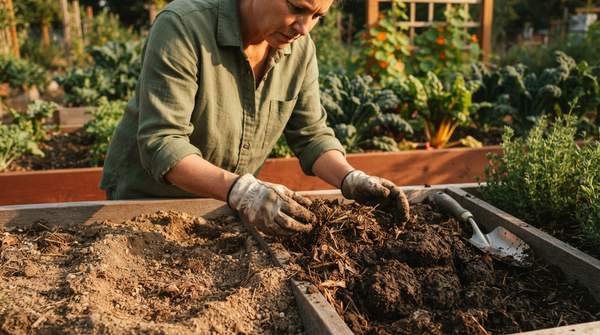
Organic matter plays a dual role here. Compost improves soil structure, water retention, and biological activity, as the Almanac's guidance notes—but it should not be relied on to make major changes in soil pH. It buffers; it does not transform. Keep amending pH with the mineral amendments the decision matrix identifies, and reserve compost for building overall soil health.
Choosing the Right pH Amendment
The amendment choice follows directly from the direction of change. To make soil less acidic, Clemson lists agricultural limestone as the common practice, with wood ashes as another option; lime-containing materials are the standard tool for raising pH in acidic soils. To make soil less alkaline, the primary tools are elemental sulfur and aluminum sulfate.
The two acidifiers work differently, and that difference matters for planning. Elemental sulfur does not acidify soil directly. Purdue University Extension, in its guidance on lowering soil pH, describes the acidifying effects of common fertilizers and amendments, and Clemson notes that elemental sulfur works by converting to sulfuric acid through bacterial action. That conversion is a biological process dependent on environmental conditions, and it takes time—soil bacteria must be active, and results will not appear overnight.
This is also why the amendment should match the situation. For an established bed where you cannot thoroughly incorporate material, Oregon State recommends applying small amounts of the appropriate material—sulfur or lime—along the drip line or in a band along a row, working with the soil you have rather than against it. And whatever you choose, follow the rates: your soil test recommendation, or in its absence, the product packaging instructions.
Timing and Application of Amendments
Timing is where gardeners most often undercut their own efforts, because pH change is slow chemistry. For new vegetable gardens, Oregon State Extension recommends applying lime to raise pH or sulfur to lower it in the fall, allowing time for the soil chemistry to adjust. The same guidance appears in the Almanac's practical advice: pH changes can take months to as much as a year, which makes fall application ideal for preparation ahead of spring planting.
For sulfur specifically, the fall window is even more important. Since the acidification depends on bacterial action in the soil, the amendment needs an extended period of biological activity before planting. Applying sulfur a few weeks before sowing tomatoes is a recipe for disappointment; applying it after last year's harvest gives the soil time to respond.
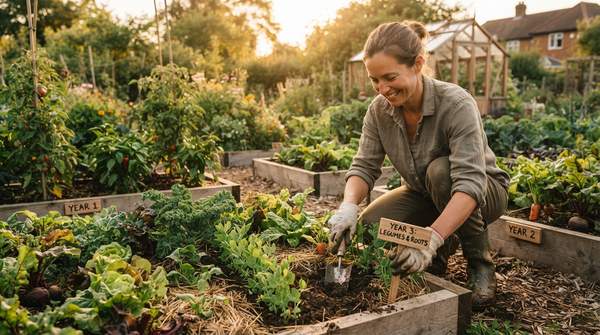
In established gardens, the approach shifts from preparation to monitoring. Watch plant health and crop yields through the season, test when something seems off, and use small, targeted applications rather than wholesale renovation. Soil conditions change over time—especially after repeated applications of fertilizers or amendments—so periodic retesting is what keeps your pH in range rather than a one-time fix.
Achieving Optimal Soil pH for a Thriving Vegetable Garden
The decision for any gardener struggling with inconsistent yields is straightforward: regularly test your soil pH and apply the appropriate amendment—lime to raise it, sulfur to lower it—considering your soil's buffering capacity, to keep the pH in the optimal range for the vegetables you actually grow. This article provides general guidance on amendment choice; specific application rates depend on precise soil test results and product instructions. The measurable indicator of success is improved plant vigor, healthier foliage, and increased yields in subsequent growing seasons—visible not on a test report, but at the dinner table, one season after you get the chemistry right.
Sources
- How to Change Soil pH in South Carolina — Home & Garden Information Center
- ASK
- Soil pH Chart and Guide: Best pH Levels for Garden Plants — Almanac.com
- Extension: Maryland extension reference table
- Tips for Growing Garden Vegetables in Utah: Soil Preparation — Extension
- Why soil pH matters — and how to manage it in your garden — OSU Extension Service
- Extension: Purdue University Extension