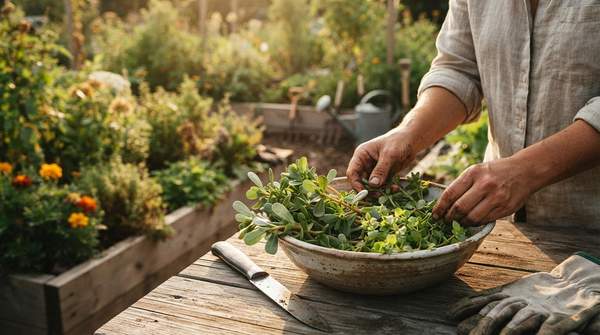
Many common garden weeds are more than just a nuisance; they are often nutritious, flavorful, and free additions to the kitchen table. With careful identification, plants often pulled and discarded can become valuable ingredients. Two of the most widespread and useful edible weeds are purslane, a succulent powerhouse of omega-3s, and chickweed, a tender green perfect for fresh salads. Learning to distinguish them from their toxic look-alikes is the first step to safely harvesting the bounty from your own backyard.
The Golden Rules of Safe Foraging
Before consuming any wild plant, absolute certainty in its identification is essential. Never use a plant for food or medicine unless you can identify it with confidence. Some edible plants, like chickweed, may have toxic species such as poison hemlock growing nearby, making careful observation critical to avoid accidental harvesting of dangerous neighbors.
The location of your harvest matters as much as the plant itself. Avoid gathering weeds from lawns, gardens, or agricultural fields that may have been treated with pesticides or heavy fertilizers. Similarly, stay away from areas with heavy foot traffic or potential pollutants. Even when harvesting from a known clean source, like your own garden, always wash the plants thoroughly before eating them.
A key identification technique for distinguishing edible plants from toxic mimics involves observing their physical characteristics closely. For instance, one of purslane's most common look-alikes is prostrate spurge. A simple test can tell them apart: break a stem. Purslane will have clear sap, while spurge will exude a milky white sap that can cause skin irritation.
Purslane (Portulaca oleracea): A Succulent Superfood
Commonly known as purslane, Portulaca oleracea is a fast-growing annual that forms a low-lying mat of succulent foliage. According to the University of Wisconsin Division of Extension, it has been cultivated for over 4,000 years as both a food and a medicinal plant. You can identify it by its smooth, reddish, prostrate stems and its thick, paddle-shaped succulent leaves. In the summer, it produces tiny yellow flowers.
Purslane is considered highly nutritious, with a better nutritional profile than many cultivated vegetables. It is unusually rich in alpha-linolenic acid (ALA), an omega-3 fatty acid more commonly found in fish and flax seeds. It also contains significant amounts of vitamins A and C, along with minerals like magnesium, calcium, iron, and potassium. However, like spinach, it is high in oxalates and should be consumed in moderation by those prone to kidney stones.
The leaves, stems, and flowers are all edible and have a tart, slightly salty flavor often compared to watercress or spinach. It can be eaten raw in salads or cooked, though heating it can make it moist and sticky. For the best texture, harvest purslane when the plants are young, before they become overly fibrous.