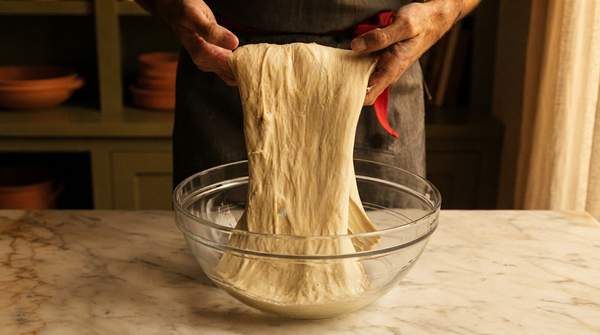
Every slice of sourdough is the visible record of a partnership between two very different microorganisms. Wild yeast fills the dough with carbon dioxide, giving bread its rise and airy crumb, while lactic acid bacteria flood it with acids that create everything from a gentle, yogurt-like tang to a sharp, vinegary bite. Understanding which microbe is responsible for which outcome is the key to reading—and eventually steering—your own bread's character.
The Microbes Behind Your Sourdough
A sourdough starter is a stabilized community of bacteria and yeast living together in flour and water, a miniature ecosystem researchers call a microbiome. What is known with certainty, as microbiologist Justine Dees explains, is that these communities include lactic acid bacteria and yeast. Unlike conventional breads that rely on commercial baker's yeast, sourdough depends on this wild partnership both to rise and to develop its taste and texture. Some starters are so stable they are preserved across generations of bakers.
Wild Yeast: The Leavening Powerhouse
Wild yeast ferments more slowly than commercial yeast, stretching the fermentation over a longer window that allows more complex flavors to develop. As enzymes in the flour break starches into maltose and glucose, the yeast consumes those sugars and releases carbon dioxide and ethanol. The gas is the engine of the loaf: trapped in the dough's elastic network, it expands during proofing and baking, producing the rise and the open, hole-studded interior bakers prize. The ethanol, meanwhile, largely dissipates in the oven's heat rather than remaining in the finished bread.
Lactic Acid Bacteria: Architects of Flavor
The bacteria are the flavor-makers. Their activity creates the slightly acidic environment that, together with the yeast's slower fermentation, develops the distinct aroma and taste associated with sourdough. The fermentation process generates mainly acids, alcohols, aldehydes, esters, and ketones—the primary route of volatile compound formation in both the dough and the crumb, according to a 2022 review by Omar Pérez-Alvarado and colleagues published in Frontiers in Microbiology. The acids also slow starch retrogradation, which helps keep the bread fresher for longer.
Lactic Acid: The Milder, Yogurt-like Tang
Not all sourness is created equal. Lactic acid contributes what Pérez-Alvarado's team describes as "fresh acidity"—a softer, rounded tang that reviewers of the sourdough microbiome compare to yogurt. This milder character comes from bacteria working through metabolic pathways that convert sugars primarily into lactic acid. Beyond sourness, lactic acid bacteria also contribute to amino acid accumulation, including glutamate, which is responsible for umami taste, and to the formation of 2-acetyl-1-pyrroline, a metabolite behind the aroma of the crust.
Acetic Acid: The Sharper, Vinegary Note
Acetic acid is the other face of sourness: what the same researchers call "sharp acidity," the sharper, more vinegary note that some starters produce. A scientific review of the sourdough microbiome notes that each microbial community can yield a unique flavor profile—some producing yogurt-like flavor from lactic acid, others a more vinegary note from acetic acid. The relative proportions of these two acids, working together to create sourdough's tangy characteristic, largely determine where a loaf falls on that spectrum.
Sourdough Microbe Contributions: Flavor and Texture Map
The table below organizes the microbial players by what they produce and what that production does to your bread, so you can trace any characteristic in the finished loaf back to its microbial source.
| Microbe / product | Metabolic output | Effect on flavor | Effect on texture |
|---|---|---|---|
| Wild yeast | Carbon dioxide and ethanol | Slower fermentation allows more complex flavors to develop | CO2 drives dough rise and an airy crumb |
| Lactic acid bacteria (general) | Organic acids, plus alcohols, aldehydes, esters, ketones | Distinctive sour flavor and aroma | Acids slow starch retrogradation, keeping bread fresher |
| Lactic acid | Produced by LAB metabolism | Milder, yogurt-like "fresh acidity" | — |
| Acetic acid | Produced by LAB metabolism | Sharper, vinegary "sharp acidity" | — |
| Homofermentative LAB | Primarily lactic acid | Act as the main acidifiers | — |
| Obligately heterofermentative LAB (e.g., Fructilactobacillus sanfranciscensis, Levilactobacillus brevis) | Lactic acid, CO2, ethanol, or acetate | Complex mix of flavor compounds | Provide CO2 essential for leavening |
One distinction within the bacterial world deserves attention. According to a review of lactic acid bacteria metabolism, homofermentative species act as the primary acidifiers, while obligately heterofermentative species—such as Fructilactobacillus sanfranciscensis and Levilactobacillus brevis—use a different pathway that generates lactic acid, CO2, ethanol, or acetate. This creates a functional synergy: heterofermenters supply gas that aids leavening alongside a broader mix of flavor compounds.
The Symbiotic Dance: Flavor and Texture in Harmony
The final loaf is a negotiation between these players. Yeast supplies the gas; bacteria supply the acids; and the balance between lactic and acetic acid decides whether the bread tastes gently tangy or aggressively sour. That balance is not fixed—it depends on which species have stabilized in a given starter, and different conditions selectively promote the formation of distinct volatile compounds, as the metabolic review notes, including both desirable esters and potentially undesirable short-chain fatty acids. This is why two starters, handled identically, can produce noticeably different breads.
Research continues to expand the cast. A Syracuse University team studying starter microbiomes found that acetic acid bacteria reliably acidified the starters they worked with and released a large variety of flavor compounds, leading researcher Rappaport to suggest that bakers seeking more sourness or new flavors might try sourcing a starter containing these bacteria or attempting to capture them.
Understanding Your Sourdough's Signature
Home bakers can better understand and appreciate the unique flavor and texture of their sourdough by recognizing the distinct roles of wild yeast and lactic acid bacteria and their metabolic byproducts. The principles here—yeast for gas, bacteria for acid, lactic for mildness, acetic for sharpness—explain why starter conditions such as temperature and hydration influence microbial activity, even though every starter's exact community is its own. The measurable test is in the next loaf: observe whether the flavor leans toward pronounced vinegar tang or mild yogurt sourness, and whether the crumb is very open or denser. Each observation tells you which microbes are dominating your starter's signature.
Sources
- The Sourdough Microbiome — ASM
- Frontiers | Role of lactic acid bacteria and yeasts in sourdough fermentation…
- The Chemistry of Sourdough: How Fermentation Shapes Flavor and Texture — AZoLifeSciences
- Sourdough Microbiome Comparison and Benefits - PMC
- MDPI
- A Tool to Enhance the Taste and Texture of Sourdough and Study the Complexity of Microbiomes — College of Arts & Sciences at Syracuse University