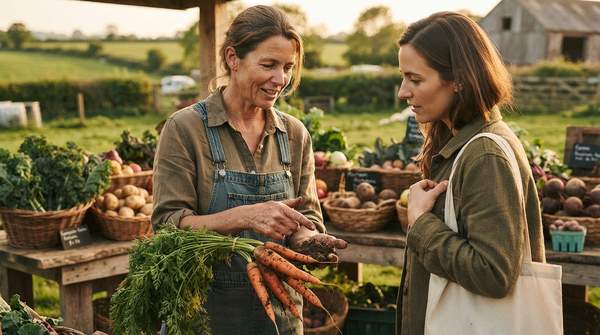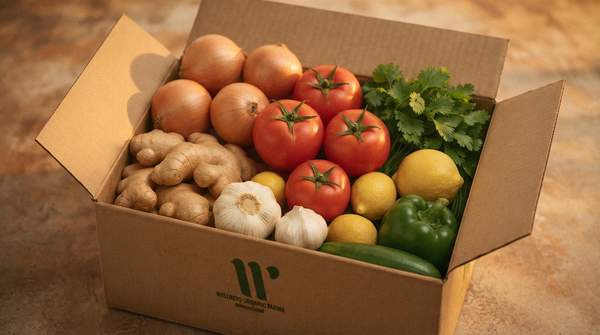
Choosing a CSA comes down to one central trade-off: the traditional model asks you to pay upfront and share the farmer's risk in exchange for deep, season-long support of a local farm, while flexible models trade some of that risk-sharing for convenience, customization, and lighter commitment. Neither is objectively better. The right choice depends on your budget, your tolerance for a mystery box of kohlrabi, and how much you want your grocery dollar to function as genuine farm support.
Understanding Community Supported Agriculture (CSA)
At its heart, a CSA is a direct partnership. The USDA's National Agricultural Library defines it as a community of individuals who pledge support to a farm operation so that the land becomes, "either legally or in spirit, the community's farm," with growers and consumers providing mutual support and sharing the risks and benefits of food production. That last phrase is doing real work: risk-sharing isn't a side effect of the traditional CSA, it's the founding principle.
SARE, the Sustainable Agriculture Research and Education program, describes the mechanics simply: community members pay a produce subscription fee before the season starts, allowing the farmer to share risk with the consumer. That early payment matters enormously to a small farm, which faces its biggest expenses—seeds, soil prep, labor—long before the first tomato ripens.
Traditional CSA: Embracing Shared Risk and Seasonal Harvests
In the classic arrangement, members pay several hundred dollars at the start of the year and receive a weekly box of produce through the spring and summer, as NPR's Hope Kirwan reported in June 2026. What's in the box is generally the farmer's choice, determined by what the fields actually produced that week. You are, in a real sense, buying a share of the harvest rather than a shopping cart of vegetables.
The consequences cut both ways. If the farm had a bad year and fewer tomatoes made it to maturity, members got fewer tomatoes—John Hendrickson, a farm viability specialist at the University of Wisconsin-Madison who helped organize some of the first CSA memberships in the Madison area in the early 1990s, puts it plainly: most consumers are not in a position to "roll the dice" with their food budget. The commitment typically spans the entire growing season, which provides the farm consistent support through its full operational cycle.
Flexible CSA Models: Convenience Meets Customization
Farmers have been actively reshaping the model to meet consumers where they are. Kirwan's reporting highlights several variations now in the field: some farms let members sign up for shorter time frames—as little as one month—and pay as they go rather than all at once. Others use online platforms that let members swap items out of their weekly box, or shift to a credit system where customers load an online card at the start of the season and decide week by week whether to buy anything at all.
Writing for Local Line, Nina Galle frames the subscription model as ideal for farms seeking recurring income and new customers—particularly people who prefer smaller commitments and greater flexibility, though it doesn't provide the full upfront payment of a traditional share. Market-style pickups and online farm stores extend the same logic: the member chooses the items rather than receiving a predetermined box.
The Core Trade-Off: Risk-Sharing vs. Consumer Choice
Here is the tension worth sitting with before you sign up. Hendrickson's assessment, via Kirwan's reporting, is that these customer conveniences move the CSA away from what it was meant to do for farms. Traditional CSA was about people taking on risk alongside farmers; a credit system or customizable box quietly hands much of that risk back to the grower, who now must predict demand, manage accounts, and absorb the uncertainty of whether members show up each week.
Convenience also costs the farmer time. Hendrickson notes that CSA has always demanded more customer service than bulk or market-stand sales, and letting consumers customize their boxes can create significant administrative work for someone who would rather be in the field. University of Missouri Extension makes a related point from the farm side: CSAs require excellent management skills because farmers must grow a large variety of crops in small volumes, limiting their ability to specialize. Flexibility, in other words, is a genuine service—and someone on the farm is paying for it in hours.
Traditional vs. Flexible CSA Models: A Comparative Framework
Use this table to locate yourself: read each row as a question about your own household, and see which column sounds more like the season you actually want.
| Decision Criterion | Traditional CSA | Flexible CSA |
|---|---|---|
| Payment Structure | Pay for a share of the harvest in advance of the season, giving the farmer working capital when it's needed most | Options include pay-as-you-go, monthly terms, or a pre-loaded credit/debit card drawn down as you choose |
| Produce Selection | Farmer's choice: a predetermined box of whatever the season delivered | Swap items in your box, choose at a market-style pickup, or select from an online farm store |
| Member Risk Level | You share the risks and rewards of farming—a lean tomato year means fewer tomatoes | Reduced direct risk-sharing; convenience shifts uncertainty and administrative burden back toward the farm |
| Commitment Term | Typically the entire growing season, providing consistent support to the farm | Can be as short as one month, or week-to-week purchasing decisions on your schedule |
The framework resolves cleanly once you name your priority. If budget predictability and direct farm support lead your list—and you enjoy being cooked into the season's surprises—the traditional column is yours. If your calendar is erratic, your household is picky, or an upfront payment is a strain, the flexible column fits your life, at the cost of stepping back from the model's founding bargain.
Making Your CSA Choice: Aligning Values with Lifestyle
Choose a CSA model based on your priority for either direct farmer support and shared agricultural risk (traditional) or greater convenience and customization in produce selection (flexible). Be honest about which promise you can keep: a traditional share only works if a surprise-heavy box thrills rather than frustrates you, and a flexible membership only serves the farm if you actually show up and spend down that credit.
The observable signal that you've chosen well is your own satisfaction with the program—consistent participation through the season, and alignment with your expectations for produce variety, payment structure, and commitment level. If by mid-season you're still picking up your box (or drawing down your balance) without dread, you've found your model. If not, that's your cue to switch columns next season.